How Businesses Can Implement Generative AI: A Practical Guide
Generative AI has moved beyond being an experimental technology used for writing emails or generating content. Businesses are increasingly exploring how it can improve customer experiences, automate repetitive work, accelerate decision-making, support employees, and create new digital products and services.
But adopting Generative AI is not as simple as choosing an AI model and giving employees access to it.
The real challenge is turning Generative AI into a reliable business capability.
Organizations need to identify the right use cases, prepare their data, evaluate security risks, establish governance, integrate AI into existing workflows, and measure whether the investment is producing business value.
This guide explains how businesses can implement Generative AI step by step, from identifying the right opportunity to scaling an AI solution across the organization.
Key Takeaways
-
Start with a business problem rather than choosing an AI tool first.
-
Prioritize Generative AI use cases based on business impact, feasibility, risk, and measurable ROI.
-
Prepare and secure business data before connecting it to AI systems.
-
Use human oversight for important decisions and customer-facing outputs.
-
Establish AI governance, security, privacy, and access controls early.
-
Begin with a controlled pilot before moving to organization-wide deployment.
-
Measure productivity, quality, cost, revenue, customer experience, and risk reduction.
-
Treat Generative AI implementation as an ongoing business transformation rather than a one-time technology project.
What Is Generative AI for Business?
Generative AI for business refers to the use of AI systems capable of generating text, images, code, summaries, recommendations, documents, and other content to support business processes.
Unlike traditional automation, which generally follows predefined rules, Generative AI can interpret natural-language instructions and produce context-specific outputs.
For example, a traditional workflow may require an employee to manually read several documents and create a summary.
A Generative AI-powered workflow could retrieve the relevant documents, summarize their key points, identify important information, and prepare a first draft for an employee to review.
This makes Generative AI particularly useful for knowledge-intensive and repetitive tasks.
However, the objective should not be to replace people simply because AI can perform a task.
The objective should be to determine where AI can make people and processes more efficient, accurate, responsive, or scalable.
Why Should Businesses Implement Generative AI?
The strongest reason to adopt Generative AI is not because competitors are using it.
It is because it can solve a measurable business problem.
Depending on the organization and use case, Generative AI can help businesses:
Improve employee productivity
Employees can use AI assistants to summarize documents, prepare meeting notes, draft communications, research topics, generate reports, and organize information.
Accelerate content production
Marketing and communication teams can use AI to create first drafts, campaign variations, product descriptions, email concepts, social media content, and content briefs.
Human review remains important for accuracy, brand consistency, originality, and strategic messaging.
Improve customer support
AI assistants can help customer service teams retrieve information, summarize previous conversations, suggest responses, and classify customer requests.
Instead of replacing support teams completely, AI can act as a support copilot that helps employees respond faster.
Support sales teams
Generative AI can help sales teams prepare account summaries, analyze customer information, create proposal drafts, summarize calls, and personalize communication.
Accelerate software development
Development teams can use AI to assist with code generation, documentation, testing, debugging, and technical explanations.
Employees often spend considerable time searching through documents, policies, presentations, knowledge bases, and internal systems.
A properly designed AI knowledge assistant can make relevant information easier to find and understand.
Generative AI Business Use Cases
One of the most important decisions is selecting the right use case.
Instead of asking:
“Where can we use AI?”
Ask:
“Which business process is slow, repetitive, expensive, knowledge-intensive, or difficult to scale?”
That question produces much better opportunities.
1. Marketing and Content
Generative AI can support:
-
Blog research and content briefs
-
Email campaign drafts
-
Social media content
-
Product descriptions
-
Ad copy variations
-
Content repurposing
-
SEO metadata
-
Market research summaries
-
Personalized marketing messages
The best approach is to use AI as a productivity layer while marketers remain responsible for strategy, positioning, originality, and final approval.
2. Customer Service
AI can assist customer service teams by:
-
Summarizing customer conversations
-
Drafting responses
-
Classifying tickets
-
Finding relevant knowledge-base information
-
Creating conversation summaries
-
Identifying recurring customer issues
-
Supporting multilingual communication
For sensitive complaints, refunds, legal issues, or policy exceptions, human approval should remain part of the workflow.
3. Sales and Business Development
Sales teams can use Generative AI to:
-
Prepare prospect summaries
-
Analyze account information
-
Draft outreach emails
-
Create proposal drafts
-
Summarize sales calls
-
Generate meeting preparation notes
-
Personalize sales collateral
-
Extract insights from customer conversations
This can reduce the administrative work that takes salespeople away from customer interactions.
4. Human Resources
Potential HR applications include:
-
Employee FAQ assistants
-
Job-description drafting
-
Interview question generation
-
Policy document summarization
-
Employee onboarding assistance
-
Training content creation
-
Internal knowledge search
Because HR information can contain sensitive employee data, access controls and privacy policies are particularly important.
5. Finance and Operations
Generative AI can help with:
-
Document summarization
-
Invoice information extraction
-
Report preparation
-
Internal financial analysis
-
Operational documentation
-
Process documentation
-
Management-report drafts
Financial decisions and sensitive transactions should not be delegated to an AI system without appropriate controls and human review.
6. Software Development
Development teams can use Generative AI for:
-
Code generation
-
Code explanation
-
Test-case creation
-
Documentation
-
Debugging assistance
-
Refactoring suggestions
-
Technical research
-
Developer knowledge assistants
AI-generated code should still go through normal security, testing, code review, and deployment processes.
How to Implement Generative AI for Business: Step-by-Step
A successful Generative AI strategy should move from business problem → use case → data → pilot → measurement → scale.
Step 1: Identify the Business Problem
Do not start by purchasing an AI platform.
Start by mapping business processes.
Look for activities that are:
-
Highly repetitive
-
Time-consuming
-
Dependent on large amounts of information
-
Expensive to perform manually
-
Difficult to scale
-
Slowing customer response
-
Creating unnecessary administrative work
-
Dependent on employees repeatedly searching for information
For example, suppose a customer-support team spends several hours every day searching internal documentation before answering customer questions.
The opportunity is not simply “use AI.”
The opportunity is:
Reduce the time required to find trusted information and prepare customer responses.
That distinction is important because it gives the project a measurable objective.
Step 2: Prioritize the Right Generative AI Use Case
Not every business process is suitable for Generative AI.
Create a simple scoring framework.
Evaluate every potential use case across five areas:
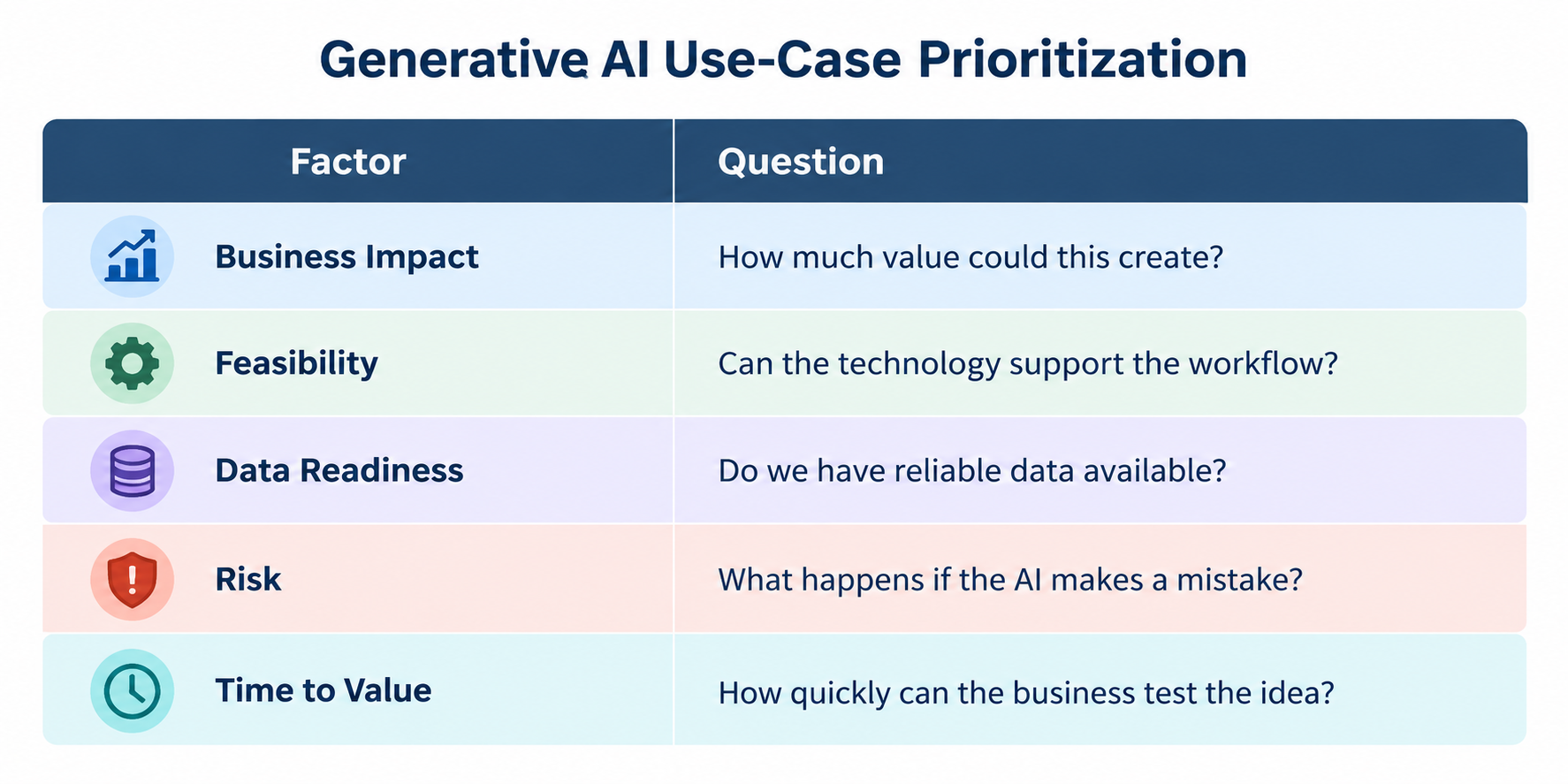
A good first project generally has:
High business impact + manageable risk + available data + measurable results.
For example, an internal knowledge assistant may be a better first project than an AI system making autonomous financial decisions.
Step 3: Define Clear Business Goals and KPIs
Before developing the solution, decide how success will be measured.
Avoid vague goals such as:
“Improve productivity with AI.”
Instead, define measurable outcomes.
For a customer-support use case:
-
Reduce average handling time
-
Increase first-response speed
-
Reduce repetitive manual work
-
Improve knowledge retrieval
-
Maintain or improve customer satisfaction
For marketing:
-
Reduce content production time
-
Increase campaign output
-
Improve campaign response rates
-
Reduce repetitive research time
For software development:
-
Reduce development cycle time
-
Increase testing efficiency
-
Reduce documentation effort
-
Improve developer productivity
A useful principle is:
If you cannot define how success will be measured, the use case may not be ready for implementation.
Step 4: Assess Your Data Readiness
Generative AI is only as useful as the information available to support the business workflow.
Before implementation, evaluate:
-
Data quality
-
Data accuracy
-
Data freshness
-
Data ownership
-
Data accessibility
-
Data classification
-
Duplicate information
-
Outdated documents
-
Sensitive information
-
Access permissions
Suppose a company wants to build an internal AI assistant.
If employees currently have access to outdated policies, duplicated documents, and inconsistent information, simply connecting an AI model to those documents will not automatically solve the problem.
The organization first needs to improve the underlying information environment.
Step 5: Choose the Right AI Architecture
Different business use cases require different technical approaches.
A company might use:
AI APIs
Useful when businesses want to integrate existing foundation models into applications and workflows.
Enterprise AI platforms
Useful when organizations require centralized management, security, monitoring, governance, and integration capabilities.
RAG allows an AI application to retrieve relevant information from approved business sources before generating a response.
This can be useful for:
-
Internal knowledge assistants
-
Customer support
-
Product information
-
Policy search
-
Technical documentation
-
Enterprise research
AI agents
AI agents can go beyond generating an answer and may perform multiple steps within a defined workflow.
However, agentic workflows require stronger permissions, monitoring, testing, and governance because the system may interact with business tools or take actions.
The architecture should therefore be selected based on the business requirement, not simply because a particular technology is trending.
Step 6: Build Security and Governance Into the Project
Security should not be added after deployment.
It should be part of the implementation from the beginning.
A business Generative AI governance framework should address:
Data privacy
Determine what information can and cannot be provided to AI systems.
Access control
Users should only be able to access information they are authorized to see.
Human oversight
Define which AI outputs require human approval.
Output validation
Test whether the system produces accurate, relevant, and safe responses.
Auditability
Maintain appropriate records of AI use, decisions, and system performance.
Third-party risk
Evaluate the security and data handling practices of external AI providers.
AI usage policy
Employees should understand which AI tools are approved and how business information can be used with them.
This is particularly important because uncontrolled employee use of public AI tools can create data security and compliance risks.
Step 7: Create a Proof of Concept
Do not immediately deploy Generative AI across the entire organization.
Start with a controlled proof of concept.
A strong pilot should have:
-
One clearly defined business problem
-
A specific group of users
-
Approved data sources
-
Defined success metrics
-
Security controls
-
Human review procedures
-
A testing process
-
A fixed evaluation period
For example, instead of launching an AI assistant for 5,000 employees, begin with one department and a defined set of business documents.
Measure performance.
Collect employee feedback.
Identify failure points.
Then improve the workflow before expanding it.
Step 8: Test AI Outputs Before Production
Generative AI does not always produce correct answers.
A business implementation therefore needs systematic evaluation.
Test for:
-
Accuracy
-
Relevance
-
Hallucinations
-
Data leakage
-
Inappropriate responses
-
Bias
-
Instruction following
-
Consistency
-
Response time
-
Cost per interaction
Create a collection of representative questions and expected outcomes.
Then compare the AI's responses against your evaluation criteria.
This gives the business an objective way to determine whether the system is ready for production.
Step 9: Integrate AI Into Existing Workflows
An AI tool becomes much more valuable when it is connected to the way employees already work.
Depending on the use case, this could mean integrating AI with:
-
CRM systems
-
ERP platforms
-
Customer-support systems
-
Document repositories
-
Collaboration tools
-
Business intelligence platforms
-
Marketing platforms
-
Internal knowledge bases
-
Software-development environments
The goal is not to create another application employees have to remember to use.
The goal is to embed AI into the workflow where the business problem already exists.
Step 10: Train Employees and Encourage Responsible Adoption
Technology alone does not guarantee adoption.
Employees need to understand:
-
What the AI system can do
-
What it cannot do
-
Which information they can provide
-
When human review is required
-
How to identify incorrect AI output
-
How to report problems
-
How AI changes their existing workflow
Training should focus on real business scenarios rather than generic AI demonstrations.
For example, instead of teaching employees only how to write prompts, show them how AI can help them complete their actual daily tasks.
Step 11: Measure ROI
Generative AI projects should be evaluated like other business investments.
Consider four categories of value.
Productivity
Measure:
-
Hours saved
-
Task completion time
-
Output per employee
-
Workflow cycle time
Financial impact
Measure:
-
Cost reduction
-
Cost avoidance
-
Revenue contribution
-
AI operating costs
-
Cost per task
Customer impact
Measure:
-
Response time
-
Customer satisfaction
-
Resolution time
-
Engagement
-
Retention
Quality and risk
Measure:
-
Error rates
-
Escalation rates
-
Compliance incidents
-
Human correction rates
-
Security events
A useful ROI calculation is:
AI ROI = (Business Value Generated − AI Investment) ÷ AI Investment × 100
The calculation should include more than software licensing.
Consider implementation, integration, infrastructure, employee training, monitoring, security, and ongoing maintenance.
Common Mistakes Businesses Make When Implementing Generative AI
1. Starting With the Technology
Buying an AI platform before identifying the business problem can result in low adoption and unclear ROI.
Start with the workflow.
2. Trying to Automate Everything
Not every process should be automated.
High-risk decisions may require human judgment.
3. Ignoring Data Quality
Poor-quality information can produce poor AI outputs.
Data preparation should be treated as a core part of the project.
4. Deploying Without Governance
Without clear rules, businesses may face data exposure, inconsistent usage, compliance issues, and uncontrolled AI costs.
5. Measuring Adoption Instead of Business Value
The number of employees using an AI tool is not enough.
The more important question is:
What changed because they used it?
6. Treating the Pilot as the Final Product
A proof of concept demonstrates potential.
Production deployment requires stronger security, reliability, monitoring, integration, support, and governance.
7. Ignoring Employee Adoption
If AI makes a workflow more complicated, employees may simply stop using it.
The solution should make their work easier, not create another layer of complexity.
A Practical 90-Day Generative AI Implementation Roadmap
Businesses looking for a structured starting point can divide implementation into three phases.
Days 1–30: Discover and Prioritize
Focus on:
-
Business-process assessment
-
AI opportunity identification
-
Use-case prioritization
-
Data assessment
-
Risk assessment
-
Stakeholder alignment
-
KPI definition
Output: One prioritized Generative AI use case with measurable goals.
Days 31–60: Build and Test
Focus on:
-
Solution architecture
-
Data preparation
-
AI model selection
-
RAG or integration requirements
-
Security controls
-
Prototype development
-
User testing
-
Output evaluation
Output: A tested proof of concept.
Days 61–90: Pilot and Measure
Focus on:
-
Controlled production pilot
-
Employee training
-
Workflow integration
-
Performance monitoring
-
User feedback
-
ROI measurement
-
Risk monitoring
-
Scale-up planning
Output: Evidence showing whether the use case should be expanded.
How to Know If Your Business Is Ready for Generative AI
Your organization may be ready to implement Generative AI if:
-
You have a clearly defined business problem.
-
The process involves repetitive or knowledge-intensive work.
-
Relevant business data is available.
-
Leadership supports experimentation.
-
The organization can define measurable KPIs.
-
Security and data access requirements are understood.
-
Employees are willing to adopt new workflows.
-
There is an owner responsible for the AI initiative.
If these conditions are not present, the first step may not be AI implementation.
It may be processing improvement and data readiness.
That preparation can make a future AI project significantly more successful.
The Future of Generative AI for Business
Generative AI is moving from standalone chat interfaces toward integrated business workflows.
The next stage of adoption will increasingly involve AI working alongside employees, retrieving organizational knowledge, interacting with business applications, and assisting with multi-step processes.
This means businesses will need to think beyond:
“Which AI tool should we buy?”
The more important questions are:
-
Which workflows should AI improve?
-
What data should AI access?
-
What decisions require human approval?
-
How will the system be secured?
-
How will performance be measured?
-
How will the solution scale?
Organizations that answer these questions before deployment will be better positioned to turn Generative AI from an experiment into a practical business capability.
How Dhanyaayai Can Help Businesses Implement Generative AI
Implementing Generative AI successfully requires more than access to an AI model.
Businesses need the right combination of AI strategy, data, cloud infrastructure, cybersecurity, integration, governance, and ongoing optimization.
Dhanyaayai helps businesses explore and implement technology solutions designed around their specific operational and business requirements.
From identifying suitable AI opportunities to building secure technology environments and supporting scalable enterprise solutions, the right implementation approach can help organizations move from AI experimentation toward measurable business outcomes.
If your organization is evaluating Generative AI, start with the business problem, identify the right use case, assess your data and security requirements, and build a controlled pilot before scaling.
Ready to explore Generative AI for your business?
Contact Dhanyaayai today to discuss your requirements.