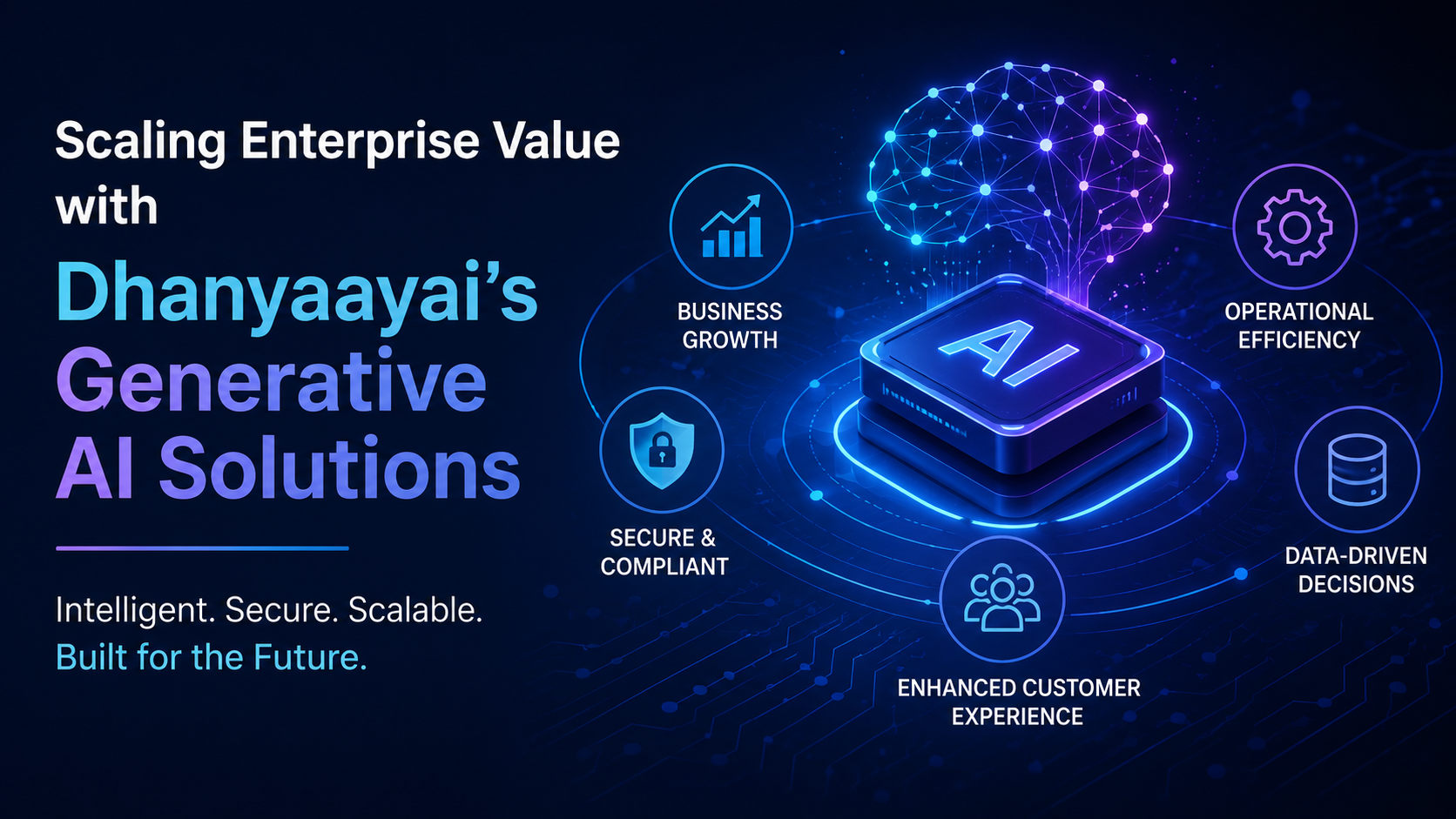
Scaling Enterprise Value with Dhanyaayai’s Generative AI Solutions
Scaling Enterprise Value with Dhanyaayai’s Generative AI Solutions
The enterprise landscape is undergoing a fundamental transformation. For years, organizations focused on converting analog data into digital formats and building cloud-native infrastructure. Today, digital transformation has shifted focus. The modern goal is to deploy artificial intelligence that doesn't just store or organize information, but actively interprets, reasons, and acts upon it.
At the center of this movement are Generative AI Solutions. Across every industry, leaders are looking past basic chatbots and generic automation to find enterprise-grade AI frameworks capable of executing complex workflows, maintaining zero-trust security, and reducing administrative latency. Dhanyaayai has positioned itself directly at this intersection, providing tailored AI integration, hybrid cloud optimization, and digital strategy designed to move AI out of sandbox environments and directly into operational ecosystems.
To build sustainable organizational momentum, enterprise technology must bridge theoretical capability with real-world execution. Generative AI achieves this by combining large learning models (LLMs), deep neural networks, and domain-specific knowledge bases to transform raw organizational intelligence into active enterprise productivity.
Moving Beyond the Hype: The Operational Architecture of Modern AI
Generative AI is a natural evolutionary leap forward in enterprise software. Where legacy automation tools required strict rules, structured databases, and rigid logical trees, modern generative architectures operate on context, intent, and semantic understanding. This shift changes how employees interact with technology and how organizations serve their clients.
Rather than forcing users to learn complex system navigation or write specialized code, generative tools allow teams to converse with enterprise data using natural language. However, scaling these capabilities safely requires a sophisticated architectural approach that balances model performance with organizational privacy and data governance.
Grounding and Retrieval-Augmented Generation (RAG)
A significant operational challenge when deploying off-the-shelf LLMs in business settings is model "hallucination" , the tendency of a language model to generate plausible but incorrect or unverified information. In enterprise, government, and heavily regulated environments, unverified outputs introduce unnecessary risk.
To eliminate this vulnerability, Dhanyaayai’s Generative AI Solutions emphasize grounding and Retrieval-Augmented Generation (RAG). Grounding anchors the AI model directly to verifiable, enterprise-owned information sources, such as internal knowledge bases, policy repositories, and historic case files.
RAG acts as a dynamic pipeline between the underlying language model and live enterprise databases. When a query is submitted, the system retrieves relevant, real-time facts from verified sources before the model synthesizes a response. This ensures that the generated output is accurate, fully traceable to source documentation, and updated instantaneously whenever underlying databases change.
Multi-Modal Intelligence and API-Driven Orchestration
Enterprise workflows rarely exist in a single format. Modern business operations process unstructured text, structured spreadsheets, audio files, technical diagrams, and video assets. Advanced generative frameworks leverage multi-modal models to process and generate insights across these varied mediums seamlessly.
Furthermore, the true power of AI unfolds when models interact with operational software. By leveraging Application Programming Interfaces (APIs), generative solutions can be connected directly to enterprise resource planning (ERP) platforms, customer relationship management (CRM) portals, and specialized databases. This API-driven connectivity enables AI to perform actionable functions such as initiating workflows, checking live inventory, or fetching real-time service updates rather than merely serving as an isolated answer engine.
Key Enterprise Impact Areas for Generative AI
Deploying Generative AI Solutions requires selecting use cases that balance feasibility with maximum operational return. By focusing on high-friction areas within business and public sector ecosystems, organizations can achieve measurable improvements in efficiency, compliance, and experience.

1. Accelerating Onboarding and Knowledge Discovery
In large enterprises and public agencies, bringing new employees, vendors, or contractors up to speed is often delayed by vast amounts of fragmented information spread across PDFs, legacy databases, and policy portals.
Generative AI changes this dynamic by acting as an intelligent conversational interface over institutional knowledge. New hires can query complex internal documentation using everyday conversational phrases and receive instant, plain-language summaries grounded in verified company data. This reduces the time required for new personnel to reach peak productivity, preserves institutional memory during staffing transitions, and minimizes the administrative burden on veteran staff.
2. Navigating Complex Regulatory and Planning Processes
Navigating multi-step approval workflows such as commercial permitting, regulatory compliance, or tax reporting often requires cross-referencing multiple departments and evolving statutes.
Generative solutions serve as proactive guides throughout these complex journeys. For example, when an applicant submits documentation for a commercial license, an integrated AI assistant can review the submission against current policy, flag missing steps, and proactively recommend additional certifications needed based on historical precedent. Furthermore, AI reasoning capabilities allow organizations to track statutory updates over time, giving teams instant clarity on how policies evolved from year to year.
3. Strengthening Cyber Defenses and Operational Security
As modern enterprise architectures grow more interconnected, security operations centers (SOCs) face an overwhelming volume of system alerts and potential threat vectors. Many security teams lack the bandwidth to manually investigate every anomaly.
Generative AI serves as a powerful force multiplier for cyber defense teams. Security-focused AI applications continuously scan network environments, flag hidden vulnerabilities, and synthesize complex malware code into clear plain-language explanations. This enables security personnel to quickly understand the scope of a threat and execute response protocols. Additionally, enterprise-grade AI frameworks enforce strict role-based access controls and data masking, preventing sensitive operational data from leaking into external model training sets.
4. Expanding Reach through Multilingual Translation and Personalization
Organizations operating in diverse environments frequently struggle to maintain high-quality, localized engagement across different languages and user personas.
Generative models automatically translate complex web portals, documentation, and transactional forms into dozens of languages while preserving precise domain context. This capability allows organizations to broaden their reach and improve accessibility for diverse populations. Beyond translation, AI-driven analytics analyze user behavior and intent to deliver personalized navigation and content, ensuring users find exact resources without navigating unnecessary pages.
Strategic Roadmap for Responsible AI Adoption
Implementing Generative AI Solutions successfully requires more than installing software; it demands a deliberate, secure, and measured strategy. To build long-term value while mitigating operational risk, organizations should follow a structured adoption roadmap.

Establishing Responsible AI Policies
Rather than imposing restrictive bans that slow down innovation, progressive organizations establish clear policies for ethical AI usage. This includes setting explicit boundaries on what data can be processed by external services, defining human-in-the-loop oversight requirements
for automated decisions, and maintaining transparency regarding how AI models generate output.
Creating Safe Testing Sandboxes
Before deploying AI into core production systems, organizations should establish isolated sandbox environments. Sandboxes allow developers, operational leads, and policy teams to experiment with prompt engineering, test multi-modal workflows, and evaluate model limits without exposing proprietary enterprise data or risking operational disruptions.
Prioritizing Partner Selection
The generative landscape is evolving rapidly, making vendor selection a critical strategic decision. Organizations should partner with solution providers that offer proven enterprise experience, cloud-native scalability, robust API access, and strict data privacy standards. A strong strategic partner ensures that your AI stack remains adaptable as new foundation models and hardware capabilities emerge.
The Road Ahead: Enterprise Agility in the AI Era
Generative AI is no longer a speculative technology; it is a core engine for modern efficiency, scaling capacity, and competitive advantage. By moving from static information silos to dynamic, conversational knowledge networks, organizations can streamline administrative tasks, strengthen security postures, and deliver exceptional experiences to both internal teams and external constituents.
Through targeted strategies, grounded architectures, and robust governance, Dhanyaayai’s Generative AI Solutions empower enterprises to navigate digital transformation with clarity and confidence. The organizations that embrace these technologies responsibly today will lead their industries in operational agility, productivity, and resilience tomorrow.
How DhanyaayAI Delivers Enterprise Generative AI Solutions
At Dhanyaayai, we help organizations transform the way they work by delivering secure, scalable, and business-focused Generative AI Solutions.
Our approach goes beyond implementing AI models. We work closely with businesses to understand operational challenges, identify high-impact opportunities, and deploy AI solutions that integrate seamlessly with existing IT environments.
Dhanyaayai's Generative AI capabilities include intelligent enterprise chatbots, AI-powered knowledge assistants, document intelligence, workflow automation, content generation, predictive analytics, and customized AI models designed for industry-specific requirements.
Security remains at the core of every implementation. Our solutions emphasize responsible AI practices, data privacy, governance, and enterprise-grade security, enabling organizations to innovate without compromising compliance or customer trust.
Whether your goal is improving employee productivity, modernizing customer engagement, accelerating software development, or automating business processes, DhanyaayAI provides the expertise and technology needed to achieve measurable business outcomes.

Conclusion
Generative AI is no longer an emerging technology reserved for innovators; it has become a strategic business necessity. Organizations that adopt enterprise-ready Generative AI Solutions can improve operational efficiency, accelerate innovation, enhance customer experiences, and empower employees with intelligent digital assistance.
Success, however, depends on implementing AI responsibly, securely, and with a clear business strategy. Companies that combine advanced AI capabilities with strong governance and expert guidance will be best positioned to thrive in an increasingly AI-driven economy.
If your organization is ready to unlock the full potential of artificial intelligence, partnering with an experienced technology provider like Dhanyaayai can help you transform ideas into measurable business value.
Frequently Asked Questions
1. What are Generative AI Solutions?
Generative AI Solutions are AI-powered technologies that create new content such as text, images, code, reports, and business insights while automating workflows and improving productivity.
2. Which industries benefit most from Generative AI?
Healthcare, banking, manufacturing, retail, education, IT, logistics, customer service, and marketing are among the industries seeing significant benefits from enterprise AI adoption.
3. Are Generative AI Solutions secure for enterprises?
Yes. Enterprise-grade AI solutions include encryption, role-based access control, governance frameworks, compliance measures, and secure deployment models to protect sensitive business data.
4.How can businesses start implementing Generative AI?
Organizations should identify high-value use cases, prepare quality data, establish governance policies, integrate AI with existing systems, and work with experienced implementation partners.
5.Why choose DhanyaayAI for Generative AI Solutions?
Dhanyaayai delivers secure, scalable, and customized Generative AI Solutions that help businesses automate operations, improve decision-making, enhance customer experiences, and accelerate digital transformation while maintaining enterprise-grade security and compliance.