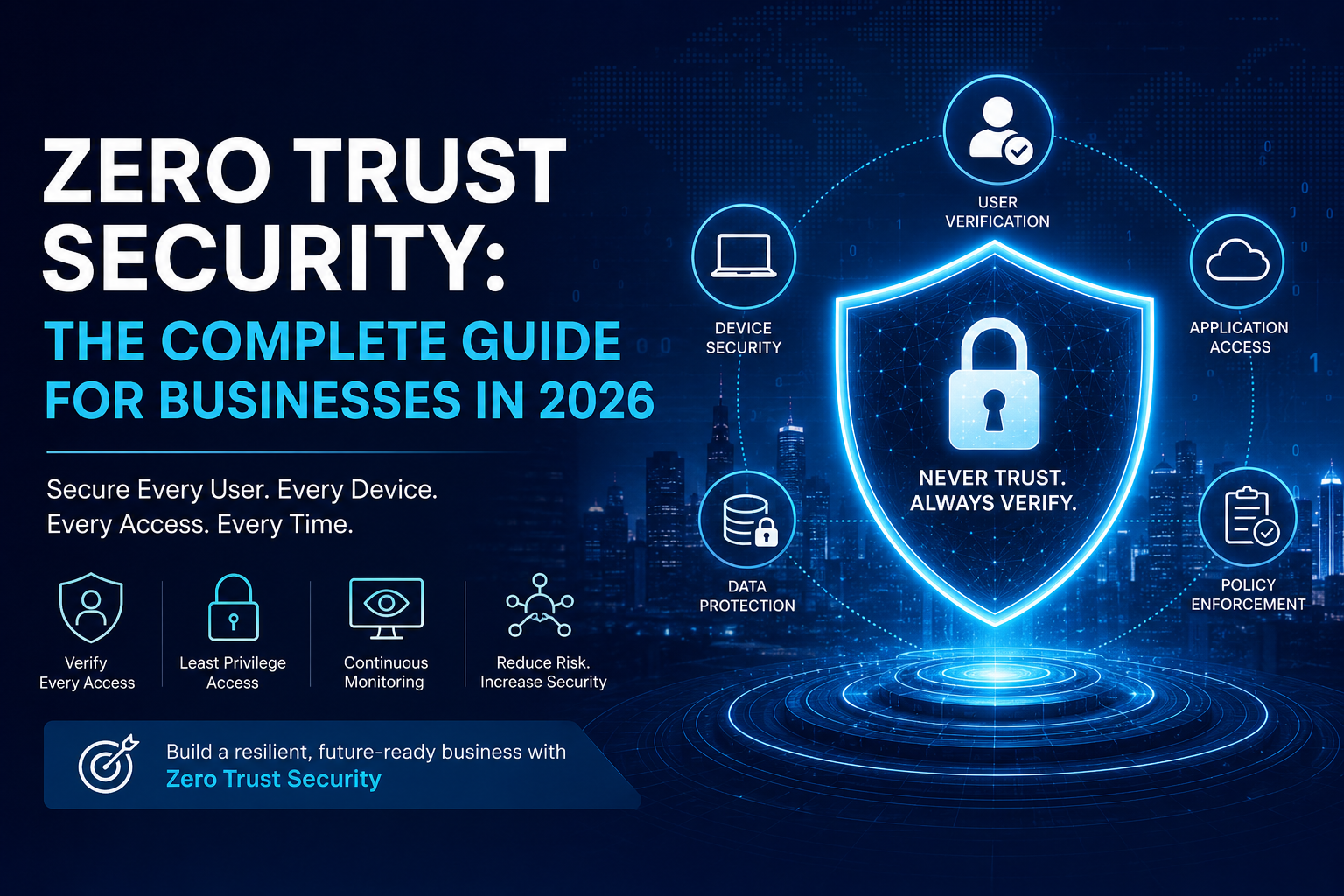
Zero Trust Security: The Complete Guide for Businesses in 2026
Zero Trust Security: The Complete Guide for Businesses in 2026
Cybersecurity has entered a new era. Businesses today face ransomware, AI-powered phishing, identity theft, insider threats, supply-chain attacks, and cloud security risks. At the same time, employees are accessing business applications from homes, airports, client locations, and personal devices.
With applications and data spread across cloud platforms, SaaS applications, and on-premises infrastructure, the traditional idea of a secure network perimeter is no longer enough.
This is where Zero Trust Security becomes important.
Zero Trust follows a simple principle: Never Trust, Always Verify. Instead of automatically trusting users or devices inside a corporate network, every access request is verified based on identity, device security, location, behavior, and risk.
Zero Trust is not a single security product. It is a security strategy that combines identity management, least-privilege access, endpoint security, continuous monitoring, and intelligent access controls.
Why Traditional Security No Longer Works
Traditional cybersecurity relied heavily on firewalls, VPNs, antivirus software, and network boundaries. Once a user successfully entered the corporate network, they were often given broad access to internal resources.
This approach worked when employees, applications, and data were mainly located within a single office network. Modern businesses, however, operate across cloud platforms, remote locations, third-party services, and multiple devices.
Attackers have also changed their approach. Instead of directly attacking a company's infrastructure, they increasingly target user identities through phishing, stolen passwords, social engineering, and credential theft.
Once attackers obtain legitimate credentials, they may move through the network and access sensitive systems.
Zero Trust addresses this problem by removing implicit trust and continuously verifying users, devices, applications, and access requests.
What Is Zero Trust Security?
Zero Trust Security is a cybersecurity framework where no user, device, application, or connection is automatically trusted.
Every access request must be authenticated, authorized, and continuously evaluated before access is granted.
For example, when an employee tries to access a sensitive application, Zero Trust can evaluate their identity, device health, location, login behavior, and risk level. If the activity appears suspicious, the system can request additional authentication or block access.
Another important principle is least-privilege access. Employees receive only the access they need to perform their responsibilities. This reduces the potential damage if an account or device is compromised.
Micro-segmentation provides another layer of protection by separating networks and workloads into smaller zones. If attackers compromise one area, their ability to move to other critical systems is restricted.
Core Principles of Zero Trust
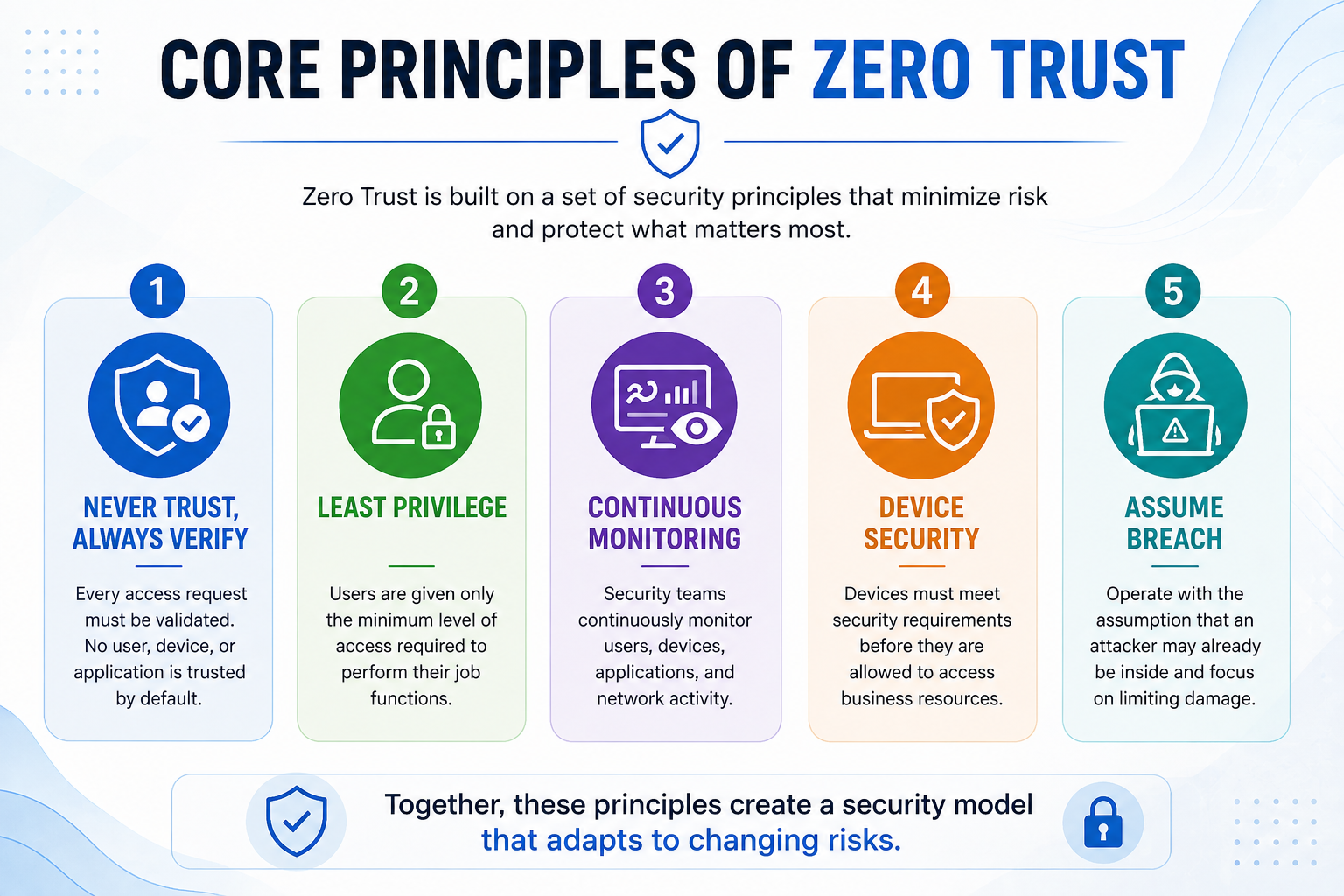
Zero Trust is built around several important principles.
Never Trust, Always Verify: Every access request must be validated instead of being automatically trusted.
Least Privilege: Users receive only the permissions required for their roles.
Continuous Monitoring: Security teams continuously monitor users, devices, applications, and network activity.
Device Security: Devices must meet security requirements before accessing business resources.
Assume Breach: Organizations should operate with the assumption that an attacker may already be inside the environment and focus on limiting damage.
Together, these principles create a security model that adapts to changing risks.
How Zero Trust Works
When a user requests access to a business application, Zero Trust first verifies their identity using methods such as passwords, biometrics, or Multi-Factor Authentication (MFA).
The system then evaluates the security condition of the device, including operating system updates, encryption, endpoint protection, and compliance status.
Next, contextual information such as location, network, login history, application sensitivity, and user behavior is analyzed.
If the request meets the organization's security policies, access is granted—but only to the required resource.
Monitoring continues after login. If unusual activity occurs, such as large downloads of sensitive information or suspicious login patterns, access can be restricted or additional authentication can be requested.
This continuous verification helps reduce the risk of stolen credentials and unauthorized lateral movement.
Key Components of Zero Trust Architecture
A successful Zero Trust strategy combines several security technologies.
Identity and Access Management (IAM) ensures that employees, contractors, partners, and other users are properly identified and authorized.
Multi-Factor Authentication (MFA) adds another layer of protection, making stolen passwords less useful to attackers.
Endpoint Security monitors laptops, desktops, mobile devices, and servers to ensure they meet security requirements.
Zero Trust Network Access (ZTNA) provides application-specific access rather than giving users broad access to an entire corporate network.
Micro-segmentation separates critical workloads and systems, limiting an attacker's ability to move across the environment.
Continuous Monitoring and Analytics use technologies such as SIEM, UEBA, EDR, and AI-powered security solutions to identify suspicious activity.
Together, these technologies create multiple layers of protection across users, devices, networks, applications, and data.
Business Benefits of Zero Trust Security
Zero Trust provides benefits beyond cybersecurity.
By limiting access and continuously verifying users and devices, organizations can reduce their overall attack surface. Least-privilege access also limits the damage caused by compromised accounts.
Zero Trust can help contain ransomware by restricting lateral movement between systems. It also supports remote and hybrid work by allowing employees to securely access specific applications without exposing the entire corporate network.
Another benefit is improved visibility. Security teams can gain better insight into user activity, device health, and application access, helping them detect and respond to threats faster.
Zero Trust can also support organizations in meeting security and data protection requirements by strengthening access controls, monitoring, and audit capabilities.
Real-World Zero Trust Use Cases
Zero Trust can be applied across industries.
In banking and financial services, organizations can use MFA, behavioral monitoring, and risk-based access controls to protect customer accounts and financial systems.
In healthcare, Zero Trust can ensure that doctors, nurses, administrators, and other employees only access the patient information required for their roles.
In manufacturing, micro-segmentation can help isolate operational technology and Industrial IoT environments from corporate networks, reducing the risk of production disruption.
For education, Zero Trust can protect learning platforms and institutional systems accessed by students, faculty, and staff from different locations and devices.
Retail organizations can use Zero Trust to protect payment systems, customer information, and e-commerce applications.
AI and Zero Trust Security
Artificial Intelligence is becoming an important part of modern Zero Trust strategies.
AI and machine learning can analyze normal user and device behavior and identify unusual activity. For example, if an employee suddenly logs in from different countries or downloads an unusually large amount of sensitive information, the system can increase the user's risk score and trigger additional security controls.
AI can also help security teams prioritize alerts, reduce false positives, and automate parts of incident response.
As cybercriminals increasingly use AI to improve phishing, social engineering, and attack automation, combining AI-powered security with Zero Trust can help organizations detect threats faster and respond more intelligently.
Challenges of Implementing Zero Trust
Zero Trust can provide significant benefits, but implementation requires planning.
Legacy applications may not support modern identity-based security controls and may require gradual modernization. Organizations may also need to improve visibility into users, devices, applications, workloads, and data before creating effective access policies.
Employee experience is another consideration. However, modern adaptive authentication can reduce unnecessary authentication requests by applying stronger controls mainly when risk increases.
Organizations do not need to transform their entire infrastructure at once. A phased approach can help businesses introduce Zero Trust gradually while reducing disruption and managing costs.
Zero Trust Adoption Roadmap
Businesses can begin their Zero Trust journey by identifying their most valuable applications, data, and systems.
Next, create an inventory of users, devices, applications, and workloads. This provides the visibility needed to establish appropriate access policies.
Organizations should then strengthen identity security with IAM, MFA, and role-based access controls, followed by endpoint security and device compliance.
Sensitive workloads can gradually be protected through micro-segmentation, while continuous monitoring can help detect suspicious behavior.
A practical approach is to begin with high-value applications and expand the Zero Trust strategy over time. Zero Trust should be treated as an ongoing security strategy rather than a one-time project.
Why Businesses Choose Dhanyaayai for Zero Trust Security
Implementing Zero Trust requires more than deploying individual security technologies. Businesses need a strategy that connects identity, endpoint security, cloud protection, monitoring, and data security.
Dhanyaayai helps organizations strengthen their cybersecurity posture and adopt modern security practices suited to their business environment.
Dhanyaayai can help businesses assess their existing security landscape, identify vulnerabilities, and develop a practical roadmap for implementing Zero Trust principles.
As organizations move toward hybrid and multi-cloud environments, protecting applications and data across different platforms becomes increasingly important. Dhanyaayai helps businesses improve cloud security, identity-driven access controls, and visibility across their IT infrastructure.
Through modern cybersecurity solutions and continuous monitoring, organizations can improve threat detection, strengthen data protection, and respond to suspicious activity more effectively.
Dhanyaayai also focuses on long-term cyber resilience by helping businesses build security strategies that evolve with changing technologies, regulations, and cyber threats.
The Future of Zero Trust Security: 2026 and Beyond
Zero Trust is becoming an increasingly important security model as businesses adopt cloud computing, AI, hybrid work, and connected technologies.
AI-powered security will play a larger role in detecting abnormal behavior and automating threat response. Organizations will increasingly rely on intelligent systems that can identify risks in real time.
Passwordless authentication using biometrics, passkeys, and security keys is also expected to grow as businesses look to reduce credential-based attacks.
At the same time, Zero Trust Network Access (ZTNA) will continue gaining importance as organizations look for alternatives to traditional VPN-based access.
The growth of IoT, operational technology, and multi-cloud environments will further expand the need for identity-based and continuously verified security.
Looking beyond 2026, Zero Trust will increasingly become a business-wide security strategy rather than only an IT initiative. It will connect identity, cloud security, endpoint protection, data security, threat intelligence, and AI-driven automation.
Conclusion
Traditional perimeter-based security is no longer enough for today's digital businesses. With employees working remotely, applications running across multiple cloud environments, and attackers increasingly targeting identities, organizations need a more adaptive approach.
Zero Trust Security provides that approach by continuously verifying users, devices, and access requests.
Through least-privilege access, MFA, continuous monitoring, micro-segmentation, and intelligent security controls, businesses can reduce their attack surface, limit lateral movement, and strengthen cyber resilience.
Zero Trust is not a one-time implementation. It is an ongoing strategy that evolves with your business and the threat landscape.
Businesses that start their Zero Trust journey today can build a stronger security foundation while supporting digital transformation, remote work, cloud adoption, and future growth.
Ready to Strengthen Your Security with Zero Trust?
Protect your users, applications, data, and cloud environments with a modern Zero Trust approach.
Talk to Dhanyaayai today and start building a secure, resilient, and future-ready enterprise.