Too Many Security Tools? Why Indian Enterprises Need Security Stack Consolidation
For years, organizations have approached cybersecurity with a simple mindset: if one security tool is good, then more security tools must be better.
Every new threat led to another purchase. A ransomware incident encouraged the deployment of a new endpoint solution. A compliance requirement resulted in another monitoring platform. A phishing attack triggered the addition of an email security product.
Slowly, security stacks grew larger and more complicated.
Today, many enterprises have dozens of cybersecurity solutions running simultaneously. On paper, this looks like a strong security strategy. In reality, it often creates the exact opposite.
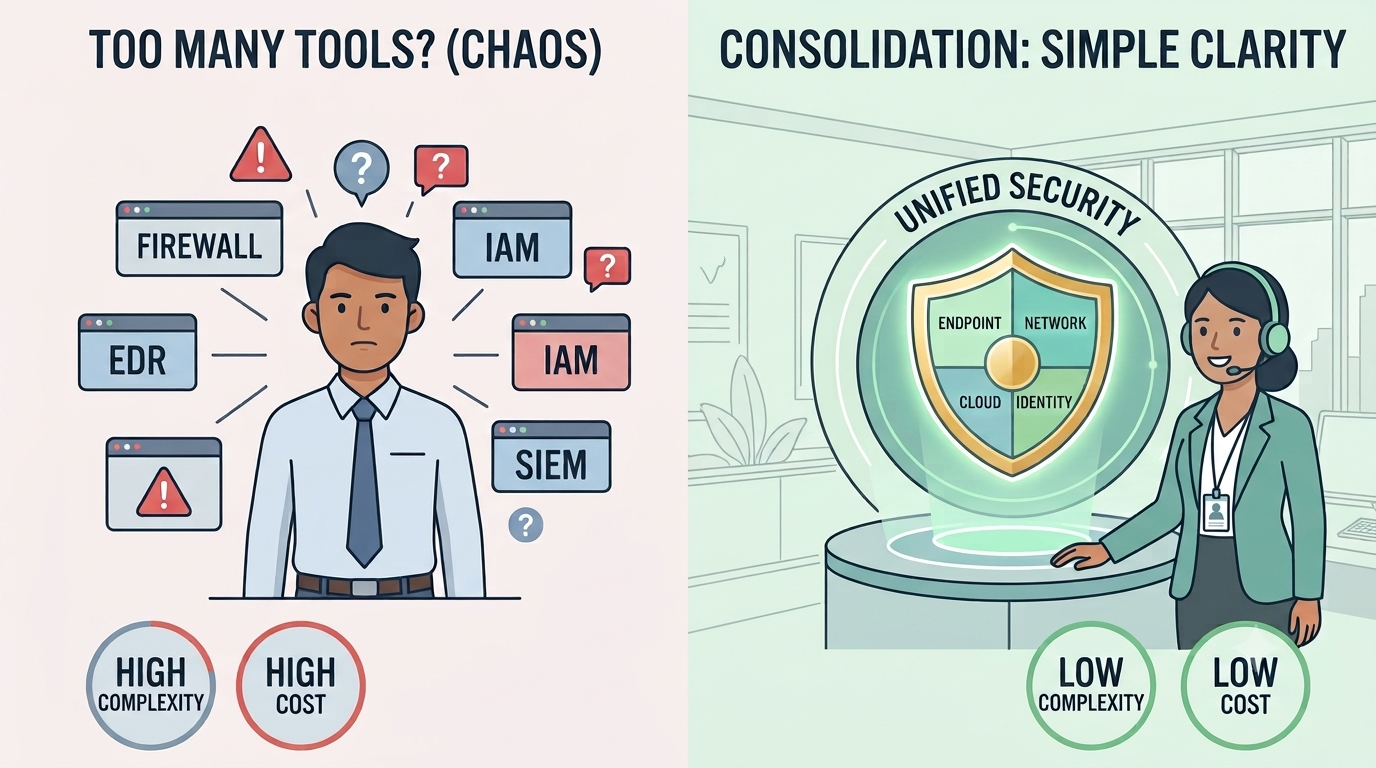
Many organizations are paying for multiple tools that perform similar functions, relying on products that have reached end-of-life, and struggling with solutions that do not communicate with one another. The result is an expensive and fragmented security environment that increases operational complexity while reducing visibility.
As cybersecurity spending continues to grow across India, organizations are beginning to ask an important question:
Are we becoming more secure, or are we simply buying more tools?
The Rise of Security Tool Sprawl
Cyber threats have become more sophisticated over the last decade. Attackers are using automation, artificial intelligence, and advanced tactics to target organizations of every size.
In response, businesses have invested heavily in security technologies.
Most enterprises now have solutions for:
- Endpoint security
- Identity and access management
- Email protection
- Cloud security
- Vulnerability management
- Network monitoring
- Security information and event management
- Data loss prevention
The challenge is not that these technologies are unnecessary. The challenge is that they are often purchased independently and implemented without a long-term strategy.
Over time, organizations accumulate products from multiple vendors. Different departments adopt their own tools. Mergers and acquisitions introduce additional platforms. Existing products remain active even after newer solutions are implemented.
Eventually, security teams find themselves managing a complex collection of disconnected technologies.
This is known as a security tool to sprawl, and it has become one of the biggest challenges facing enterprises today.
More Spending Does Not Always Mean Better Protection
Cybersecurity budgets are increasing every year. Organizations understand that the cost of a cyberattack can be enormous, both financially and operationally.
However, increasing budgets does not automatically improve security.
In many cases, additional spending introduces new problems:
- Teams have to manage more dashboards.
- More alerts are generated.
- More integrations need to be maintained.
Security teams spend more time operating tools and less time focusing on actual risk.
Instead of simplifying security operations, organizations accidentally create environments that are difficult to manage and even harder to monitor.
A company may have ten different security tools and still lack a complete understanding of what is happening inside its environment.
The result is a dangerous illusion of security.
The organization appears well protected because it has many solutions, but hidden gaps remain.
The Hidden Cost of Unused Security Tools
One of the biggest challenges in enterprise security today is underutilization.
Many organizations purchase advanced security platforms but never use their full capabilities.
- Features remain disabled.
- Licenses go unused.
- Some tools are deployed only partially.
Others continue to run even though newer products already perform the same function.
This creates a significant financial burden.
Security budgets that could be invested in modernization, employee training, or strategic initiatives are instead consumed by software that provides little value.
In large enterprises, this waste can amount to crores of rupees every year.
More importantly, underutilized tools create confusion.
Security teams may assume that a particular control exists when it has never been properly configured.
During an incident, these assumptions can lead to delayed response times and increased damage.
The Problem with Disconnected Security Tools
A modern enterprise may use products from several different vendors.
Each solution generates logs, alerts, and reports.
The problem is that many of these systems do not communicate effectively with one another.
An endpoint solution may detect suspicious activity, but that information never reaches the identity management platform.
A cloud security alert may never be correlated with a network event.
Critical pieces of information remain isolated inside individual tools.
This creates blind spots.
Attackers often take advantage of these gaps by moving through undetected environments.
Security teams are then forced to manually investigate incidents by gathering information from multiple systems.
The process is time-consuming and increases the risk of missing important indicators.
Having more tools should increase visibility.
Instead, disconnected environments often reduce it.
Why Vendor Consolidation Is Becoming a Priority
Organizations around the world are beginning to rethink their security strategies.
Rather than continuously adding new technologies, many enterprises are focusing on consolidation.
Vendor consolidation does not mean reducing security investments or removing important controls.
It means building a security ecosystem that is simpler, more integrated, and easier to manage.
Consolidation offers several benefits.
First, it reduces operational complexity.
Security teams spend less time managing multiple platforms and more time focusing on threat detection and response.
Second, it improves visibility.
Integrated tools can share information and provide a more complete view of the environment.
Third, it helps organizations reduce unnecessary spending.
Eliminating redundant products allows budgets to be redirected toward initiatives that deliver greater value.
Finally, consolidation can improve security outcomes by reducing configuration errors and simplifying management processes.
In many cases, fewer tools lead to stronger security.
The Questions Every Enterprise Should Ask
Before investing in another security solution, organizations should take a step back and evaluate their existing environment.
Some important questions include:
Are we using all the features that we already pay for?
Do multiple products perform similar functions?
Which tools are approaching end-of-life?
Are our security solutions integrated?
Can our teams efficiently manage the current environment?
Do we have complete visibility across our infrastructure?
These questions often reveal opportunities that were previously overlooked.
Many organizations discover that their biggest security improvement does not require purchasing another product.
Instead, it requires optimizing what they already have.
Building a Smarter Security Strategy
The future of cybersecurity is not about owning the largest number of tools.
It is about building a security architecture that is efficient, integrated, and aligned with business objectives.
A strong security strategy should focus on three key principles.
The first is visibility.
Organizations must understand what technologies they own and how they work together.
The second is optimization.
Existing investments should be fully utilized before additional purchases are made.
The third is simplification.
Reducing unnecessary complexity often improves both security and operational efficiency.
Security teams already face increasing challenges from sophisticated attackers, regulatory requirements, and resource limitations.
Managing an overly complicated security stack only adds to those challenges.
A streamlined environment allows teams to focus on what matters most identifying risks and responding to threats quickly.
How Dhanyaayai Can Help
At Dhanyaayai, we help enterprises evaluate their current cybersecurity environments through a comprehensive Security Stack Review.
Our approach helps organizations:
• Identify redundant and underutilized tools.
• Discover opportunities for vendor consolidation.
• Improve visibility across the security ecosystem.
• Optimize existing investments without increasing risk.
Sometimes the most valuable security investment is not a new product.
It is gaining clarity on the tools you already own.

Conclusion
Cybersecurity is no longer simply a technology challenge. It is a business strategy challenge.
Many enterprises have invested heavily in security tools over the years, but more tools have not always delivered better outcomes.
Unused licenses, overlapping capabilities, and disconnected platforms have created environments that are expensive to maintain and difficult to manage.
The organizations that will succeed in the future are not necessarily the ones with the biggest security budgets.
They are the ones that understand how to maximize the value of their existing investments, eliminate unnecessary complexity, and build integrated security ecosystems.
Before purchasing another security solution, take a closer look at your current environment.
You may discover that the biggest opportunity is not adding another tool.
It is making your existing security stack work smarter.
Is your security stack creating protection or complexity?
Get a complimentary Security Stack Review from Dhanyaayai and discover:
✔ Underutilized tools and unused licenses
✔ Ways to improve visibility without increasing spend