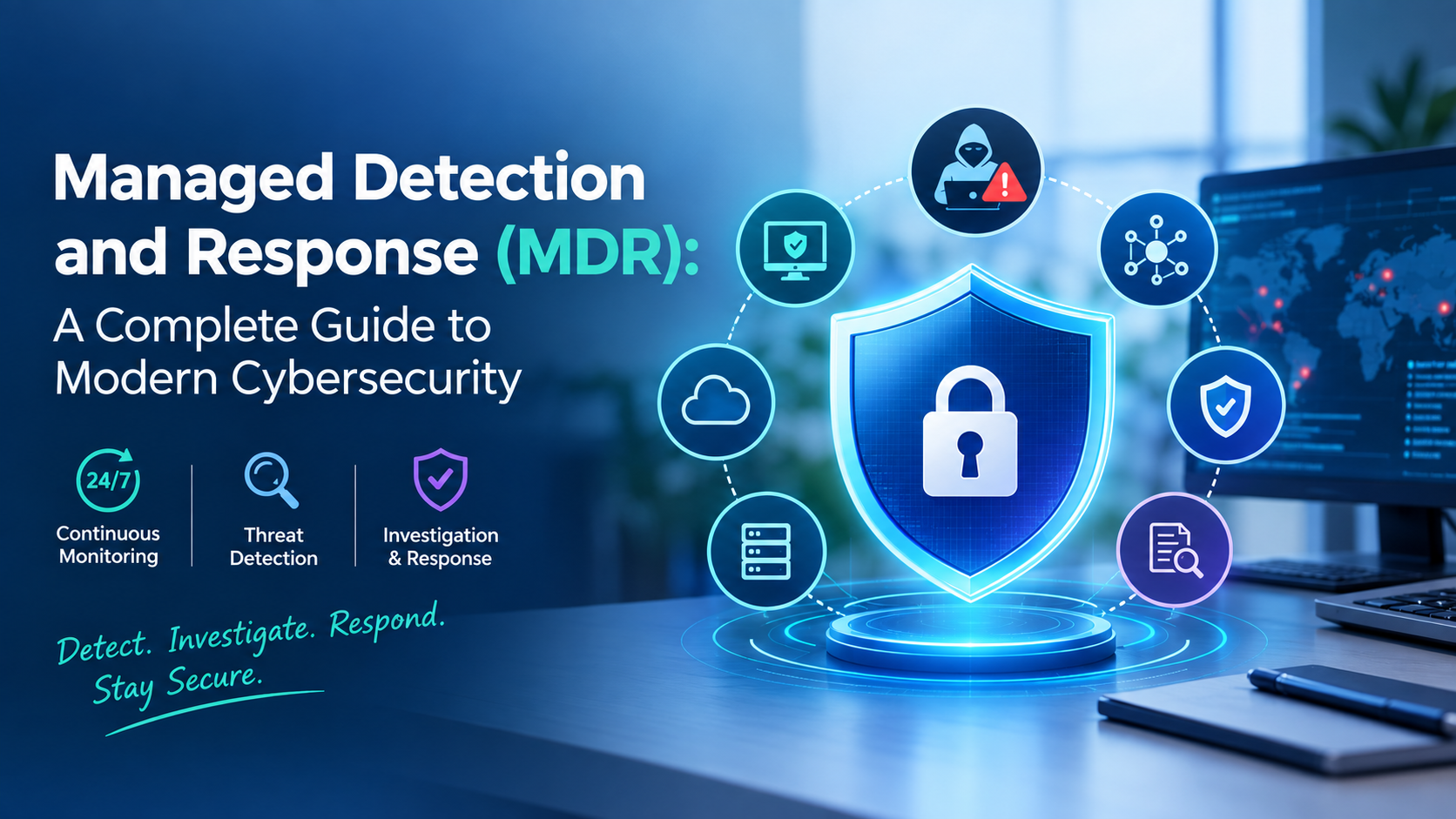
Managed Detection and Response (MDR): A Complete Guide to Modern Cybersecurity
Managed Detection and Response (MDR): A Complete Guide to Modern Cybersecurity
Cyberattacks are becoming faster, more sophisticated, and harder for businesses to detect. A phishing email can lead to stolen credentials, a compromised endpoint can become the entry point for ransomware, and suspicious activity can remain hidden inside a network for days before anyone notices.For many organizations, having security tools is no longer enough. Businesses need people and processes that can continuously monitor those tools, investigate suspicious activity, and respond quickly when a threat is discovered. This is where Managed Detection and Response (MDR) comes in.
MDR combines continuous security monitoring, advanced threat detection, investigation, and response with the expertise of cybersecurity professionals. Instead of relying entirely on an internal security team, organizations can work with an MDR provider to extend their security capabilities and respond to threats around the clock.
But what exactly is MDR, how does it work, and when should a business consider it?
Let's explore.
What Is Managed Detection and Response (MDR)?
Managed Detection and Response (MDR) is a cybersecurity service that provides continuous monitoring, threat detection, investigation, and response to security incidents.
An MDR service typically combines:
- Security technologies
- Threat intelligence
- Security analysts
- Threat hunters
- Automated detection
- Incident response capabilities
The goal isn't simply to generate security alerts. It is to determine which alerts represent genuine threats and take action before they cause significant damage.
For example, imagine an employee accidentally clicks on a phishing link. The attacker obtains their credentials and attempts to log in from an unusual location.
A traditional security tool might generate several alerts.
An MDR team can investigate the activity, correlate related events, identify the potential account compromise, and initiate an appropriate response.
That difference from alerting to investigation and response is one of the key strengths of MDR.
Why Do Businesses Need MDR?
Modern organizations operate across cloud platforms, endpoints, applications, remote networks, and SaaS environments. Every connected system can introduce another potential attack surface.
At the same time, cybersecurity teams often face challenges such as:
Growing volume of security alerts
Security products can generate thousands of alerts. Security professionals must determine which events require immediate attention.
Without sufficient expertise and resources, important threats can be buried among lower-priority notifications.
Cyberattacks happen outside business hours
Threat actors don't work according to office hours.
An attack that begins at 2 AM can continue progressing while an organization's security team is offline.
Continuous monitoring helps organizations identify suspicious activity regardless of when it occurs.
Shortage of cybersecurity professionals
Finding and retaining experienced cybersecurity professionals can be difficult and expensive.
MDR provides access to security expertise without requiring every organization to build a large internal security operations team.
Increasingly sophisticated attacks
Attackers increasingly use techniques such as credential theft, ransomware, social engineering, living-off-the-land techniques, and other methods designed to bypass traditional defenses.
MDR can combine automated detection with human analysis to identify suspicious behavior that may otherwise go unnoticed.
How Does Managed Detection and Response Work?
Although MDR services vary between providers, the process generally follows several key stages.
1. Continuous Monitoring
The MDR team continuously monitors security telemetry from sources such as endpoints, networks, cloud environments, identity systems, and security platforms.
This creates greater visibility into what is happening across the organization's digital environment.
2. Threat Detection
Advanced analytics, detection rules, behavioral analysis, and threat intelligence are used to identify suspicious activity.
For example, unusual login behavior combined with suspicious endpoint activity may indicate a compromised account.
3. Investigation and Threat Hunting
Not every alert represents a serious attack.
Security analysts investigate suspicious events and correlate information from multiple sources to understand what actually happened.
Threat hunters can also proactively search for indicators of compromise or unusual behavior that automated systems may not immediately identify.
4. Incident Response
When a genuine threat is identified, the MDR team can help contain and respond to it.
Depending on the service and organization's agreed response model, actions may include isolating a compromised endpoint, blocking malicious activity, disabling compromised credentials, or escalating the incident to internal teams.
5. Reporting and Recommendations
After an incident, organizations can receive reports explaining what happened, how it was handled, and what improvements can reduce the likelihood of similar incidents in the future.
This turns security incidents into opportunities to strengthen the organization's overall security posture.
Key Features of Managed Detection and Response
A strong MDR service typically provides several capabilities that work together.
24/7 Security Monitoring
Continuous monitoring helps detect suspicious activity even when internal teams aren't available.
Threat Detection and Investigation
MDR combines automated technologies with security analysts who investigate potentially malicious behavior.
Threat Hunting
Rather than waiting for an alert, threat hunters proactively search for signs that attackers may already be inside the environment.
Incident Response
MDR helps organizations contain and respond to confirmed threats quickly.
Threat Intelligence
Threat intelligence provides additional context about malicious IP addresses, domains, malware, attack techniques, and emerging threats.
Endpoint and Network Visibility
Monitoring endpoints, networks, identities, and cloud environments provides a broader view of potential attacks.
Security Reporting
Regular reports can help organizations understand security activity, incidents, trends, and recommended improvements.
MDR vs Traditional Security Monitoring
One common misconception is that MDR is simply another name for security monitoring.
There is an important difference.
Traditional security monitoring may focus heavily on collecting events and generating alerts.
MDR goes further by combining monitoring, detection, investigation, threat hunting, and response.
Think of it this way:
Security monitoring asks:
"Did something suspicious happen?"
MDR asks:
"What happened, is it a real threat, how serious is it, and what should we do about it?"
This investigation and response capability can make a significant difference during a security incident.
MDR vs MSSP: What's the Difference?
MDR and Managed Security Service Providers (MSSPs) are sometimes used interchangeably, but they are not necessarily the same.
An MSSP traditionally focuses on managing and monitoring security infrastructure and services.
MDR is more specifically focused on detecting threats, investigating suspicious activity, hunting for threats, and responding to security incidents.
The distinction isn't absolute because modern providers may offer overlapping services. Businesses should therefore evaluate the actual capabilities included in a service rather than choosing based solely on the label.
When evaluating an MDR provider, ask:
- Is monitoring available 24/7?
- Are experienced security analysts involved?
- Does the service include threat hunting?
- What response actions are included?
- How quickly are critical incidents escalated?
- Which environments can be monitored?
- How is threat intelligence incorporated?
Real-World Example: How MDR Can Stop an Attack
Consider a mid-sized organization with employees working remotely.
One employee receives a convincing phishing email and enters their credentials on a fake login page.
The attacker attempts to use those credentials to access company resources.
The MDR platform detects several unusual signals:
- Login from an unusual location
- Suspicious authentication behavior
- Abnormal activity from the user's endpoint
- Communication with a potentially malicious domain
Instead of treating these as isolated alerts, the MDR team correlates the activity and identifies a potential account compromise.
The security team can then help contain the incident, investigate whether the attacker accessed sensitive resources, and recommend steps such as credential resets and stronger authentication controls.
The value of MDR isn't simply that it detected one suspicious login.
It connected the dots.
Benefits of Managed Detection and Response
Faster Threat Detection
Continuous monitoring can help reduce the time between an attack beginning and the organization becoming aware of it.
Faster Response
Early containment can limit an attacker's ability to move across systems or access sensitive information.
Access to Security Expertise
Organizations gain access to cybersecurity professionals without necessarily having to build a large 24/7 internal security operation.
Reduced Pressure on Internal Teams
MDR can help security teams focus on strategic priorities while external experts handle continuous monitoring and investigation.
Improved Visibility
MDR can bring together security signals from different parts of an organization's technology environment.
Stronger Security Posture
Regular investigations, threat hunting, and recommendations can help organizations continuously improve their defenses.
How to Choose the Right MDR Provider
Choosing an MDR provider should involve more than comparing prices.
Evaluate Detection Capabilities
Ask how the provider detects threats and whether it uses behavioral analytics, threat intelligence, threat hunting, and other techniques.
Understand Response Capabilities
Find out exactly what happens after a threat is confirmed.
Does the provider only notify your team, or can it take predefined containment actions?
Check Technology Coverage
Your MDR service should support the technologies your organization actually uses, including endpoints, cloud environments, identity systems, and networks where applicable.
Examine SLAs
Understand the provider's expected response and escalation times for critical security incidents.
Review Reporting
Good reporting should provide meaningful security insights rather than simply producing large volumes of technical data.
Consider Scalability
Your security requirements may change as your organization grows. Choose a service that can scale with your users, workloads, endpoints, and cloud environments.
Is MDR Right for Your Business?
MDR can be particularly valuable for organizations that:
- Need 24/7 security monitoring
- Have a small or overloaded cybersecurity team
- Lack specialized threat-hunting expertise
- Operate across cloud and hybrid environments
- Want faster incident detection and response
- Handle sensitive business or customer information
- Need to strengthen their overall security posture
However, MDR shouldn't be viewed as a replacement for every aspect of cybersecurity.
A strong security strategy should also include identity protection, endpoint security, vulnerability management, employee awareness, backup and recovery, security policies, and appropriate access controls.
MDR works best as part of a broader cybersecurity strategy.
The Future of Managed Detection and Response
Cybersecurity is moving toward more proactive and intelligence-driven defense.
Artificial intelligence and automation are increasingly being used to analyze large volumes of security data, identify behavioral anomalies, prioritize threats, and accelerate investigations.
However, automation alone isn't enough.
Cybersecurity professionals still play an important role in understanding context, validating threats, making response decisions, and dealing with complex incidents.
The future of MDR will therefore likely involve a combination of AI-powered detection, automation, threat intelligence, proactive hunting, and human expertise.
Strengthen Your Cybersecurity with Managed Detection and Response
Cyber threats are evolving every day. Don't wait for an incident to expose gaps in your security.
Dhanyaayai helps businesses strengthen their security posture with Managed Detection and Response, advanced cybersecurity technologies, and expert security support.
Final Thoughts
Cyber threats are no longer limited to occasional security incidents. Businesses must continuously monitor their environments and be prepared to respond when suspicious activity occurs.
Managed Detection and Response (MDR) provides organizations with a proactive approach by combining continuous monitoring, advanced threat detection, expert investigation, threat hunting, and incident response.
For organizations that don't have the resources or expertise to operate a 24/7 security operation internally, MDR can provide an effective way to strengthen their security capabilities.
The key is to choose an MDR provider that understands your environment, provides meaningful threat detection, offers clear response capabilities, and works as an extension of your security team.
The goal isn't simply to detect more alerts. It's to detect the threats that matter and respond before they become business-impacting incidents.
Frequently Asked Questions
What is Managed Detection and Response (MDR)?
Managed Detection and Response (MDR) is a cybersecurity service that provides continuous monitoring, threat detection, investigation, threat hunting, and response to security incidents.
Is MDR suitable for small businesses?
Yes. MDR can be useful for small and mid-sized businesses that need 24/7 monitoring but don't have the resources to maintain a dedicated security operations team.
What is the difference between MDR and EDR?
EDR focuses primarily on detecting and responding to threats on endpoints. MDR is a managed service that can use EDR and other security technologies while providing continuous monitoring and expert investigation and response.
Does MDR replace an internal cybersecurity team?
Not necessarily. MDR can complement an internal team by providing additional expertise, continuous monitoring, threat hunting, and response support.
How does MDR help with ransomware?
MDR can help identify suspicious behaviors associated with ransomware, investigate the activity, and support rapid containment and response, potentially limiting the attack's impact.