Identity Security in 2026: Protecting Human, Machine and AI Identities
Identity is now the central security control point in modern business. Employees, contractors, applications, cloud workloads, APIs, service accounts, and AI agents all require access to digital resources. As organizations adopt cloud platforms and artificial intelligence, security teams face a rapidly expanding attack surface comprising both human and non-human identities.
This expansion creates a critical imperative: organizations must secure every identity while enforcing strict least privilege.
The 2026 Identity Security Landscape report from Palo Alto Networks, based on a survey of 2,930 cybersecurity decision-makers, illustrates the scale of this shift:
- 9 in 10 organizations experienced an identity-related breach in the past 12 months.
- Machine identities now outnumber human identities 109 to 1.
- 96% of respondents report that human identities hold more access than their roles require.
These findings demonstrate why identity security has evolved beyond basic authentication and access management. Security teams now require unified visibility and granular control over every entity interacting with their environment.
What Is Identity Security?
Identity security is the practice of protecting digital entities and governing their access across an enterprise technology environment.
An identity can represent:
- An employee, contractor, or administrator
- An application or API
- A service account or cloud workload
- A machine, server, or container
- An AI agent
Human → Application → API → Machine → AI Agent → Data
Modern identity security integrates multi-factor authentication (MFA), authorization policies, least privilege access management, regular access reviews, credential protection, and continuous monitoring. The goal is straightforward: ensure the right identity gets the right access at the right time, and automatically revoke unnecessary permissions.
Why Identity Security Matters in 2026
The enterprise identity perimeter has expanded dramatically. A single business transaction can traverse a complex chain: an employee logs into a SaaS application, which triggers an API call, executes a cloud workload, runs an automated script via a service account, and feeds data to an AI agent.
Every link in this chain represents a potential vector for privilege escalation or lateral movement if compromised. The 109:1 machine-to-human ratio underscores how quickly non-human credentials have multiplied. Without automated discovery and continuous access governance, these unmanaged access paths become significant security blind spots.
Human Identity Security and Excessive Access
While non-human entities proliferate, human users remain primary targets for credential theft, social engineering, and session hijacking. Unnecessary permissions amplify the impact of any compromised user account.
With 96% of organizations reporting excessive access permissions for human users (Palo Alto Networks), enforcing the principle of least privilege is vital. Least privilege ensures users receive only the absolute minimum permissions needed for their daily tasks.
Actionable Controls for Human Identities
- Enforce Multi-Factor Authentication (MFA): Mandate phishing-resistant MFA across all corporate and cloud assets.
- Implement Role-Based Access Control (RBAC): Map permissions directly to job roles rather than granting ad-hoc access.
- Automate Lifecycle Management: Instantly deprovision accounts and revoke access during offboarding or internal role changes.
- Eliminate Standing Privileges: Shift toward Just-In-Time (JIT) access for administrative tasks to keep baseline permissions minimal.
- Conduct Regular Access Audits: Perform periodic reviews to identify and strip inactive or orphaned permissions.
Machine Identity Security: The Growing Challenge
Applications, microservices, databases, containers, and pipelines rely on machine identities to communicate securely.
Common machine credentials include:
- API keys and access tokens
- Service accounts and cloud IAM roles
- Digital certificates (TLS/SSL, SSH)
- Embedded database and application credentials
Because machine identities are often created quickly by developers or automated systems, they are frequently overlooked during standard security reviews. Poorly managed machine credentials such as hardcoded API keys or forgotten service accounts with admin rights create massive vulnerabilities.
A robust machine identity management strategy requires automated discovery across multi-cloud environments, secure vaulting for secrets, strict permission boundary controls, and automated credential rotation.
AI Identities: A New Governance Frontier
Artificial intelligence introduces a transformative dynamic to identity architecture. Autonomous AI agents no longer just display information they actively execute business processes, execute code, access databases, and make real-time decisions with minimal human intervention.
Palo Alto Networks reports that 99% of surveyed organizations have adopted AI agents, highlighting how quickly agentic AI has entered the enterprise infrastructure.
Key Questions for Governing AI Identities
- Identity Context: What specific service account or IAM role does the AI agent operate under?
- Scope of Access: Which databases, APIs, and business systems can it read from or write to?
- Execution Limits: What specific actions is the AI agent allowed to execute independently?
- Credential Lifecycle: How are the agent's authentication tokens generated, rotated, and revoked?
- Auditability: Are all agent decisions, API calls, and data accesses logged in a centralized audit trail?
AI agents must never receive broad or persistent administrative privileges simply for operational convenience. Their access must be scoped, monitored, and governed as strictly as any high-privilege human role.
Identity Security and Zero Trust Architecture
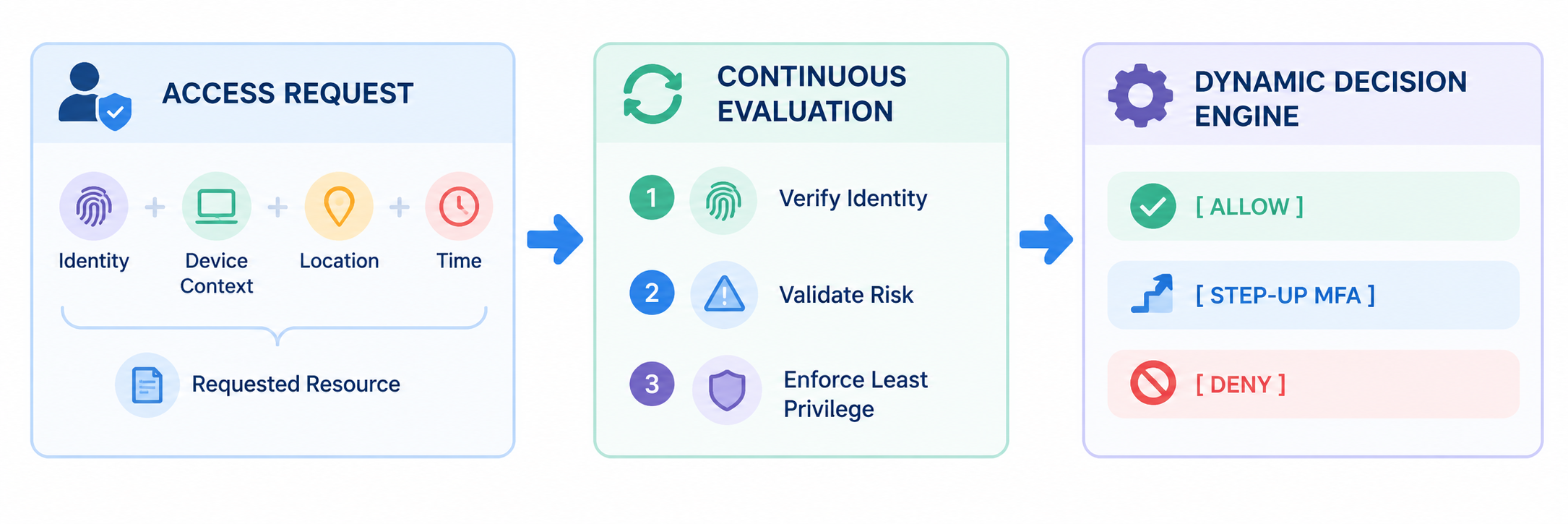
Identity security is a foundational pillar of Zero Trust Architecture. Standardized by NIST, Zero Trust relies on the core mandate: never trust, always verify.
Rather than granting implicit trust based on network location, Zero Trust evaluates every access request dynamically.image
By pairing Zero Trust principles with identity governance, organizations move from static, perimeter-based security to dynamic access decisions that continually adapt to changes in context and risk score.
Best Practices for Enterprise Identity Security
Organizations can strengthen their identity security posture by executing on seven key directives:
- Discover Every Identity: Deploy automated tools to map all human accounts, cloud workloads, service accounts, and active AI agents across hybrid systems.
- Enforce Least Privilege: Strip excessive permissions and align access rights strictly with operational requirements.
- Mandate Strong Authentication: Deploy adaptive, risk-based MFA and passwordless authentication across all endpoints and apps.
- Minimize Standing Access: Replace static elevated permissions with Just-In-Time (JIT) elevation workflows.
- Vault and Rotate Machine Secrets: Eliminate hardcoded keys by utilizing secrets managers with automated credential rotation.
- Govern Agentic AI: Assign explicit, bounded IAM identities to AI agents with full session monitoring and logging.
- Monitor and Audit Continuously: Integrate identity analytics with SIEM/XDR platforms to catch anomalous logins, unusual API calls, or rapid privilege escalations in real time.
The Future of Identity Management
Identity security is evolving into an integrated, automated ecosystem capable of governing billions of interconnected humans, machines, and AI entities.
Future-ready strategies will rely heavily on automated access lifecycle management, AI-driven risk scoring, and real-time identity threat detection and response (ITDR). The primary objective is no longer merely tracking who is logging in, but dynamically controlling what every entity can do, ensuring that unnecessary access is automatically detected and purged.
Conclusion
Identity security is foundational to modern cybersecurity resilience. Protecting human accounts is no longer enough enterprises must secure the vast mesh of machine credentials and autonomous AI agents that run modern business operations.
Organizations that establish full visibility, enforce strict least privilege, and integrate identity governance into a broader Zero Trust framework will significantly reduce their attack surface and mitigate breach risks.
The critical baseline question for security leaders in 2026 is no longer just "Who is logging in?"
It is: "Who or what is accessing our systems, what specific permissions does it hold, and is that access still necessary right now?"