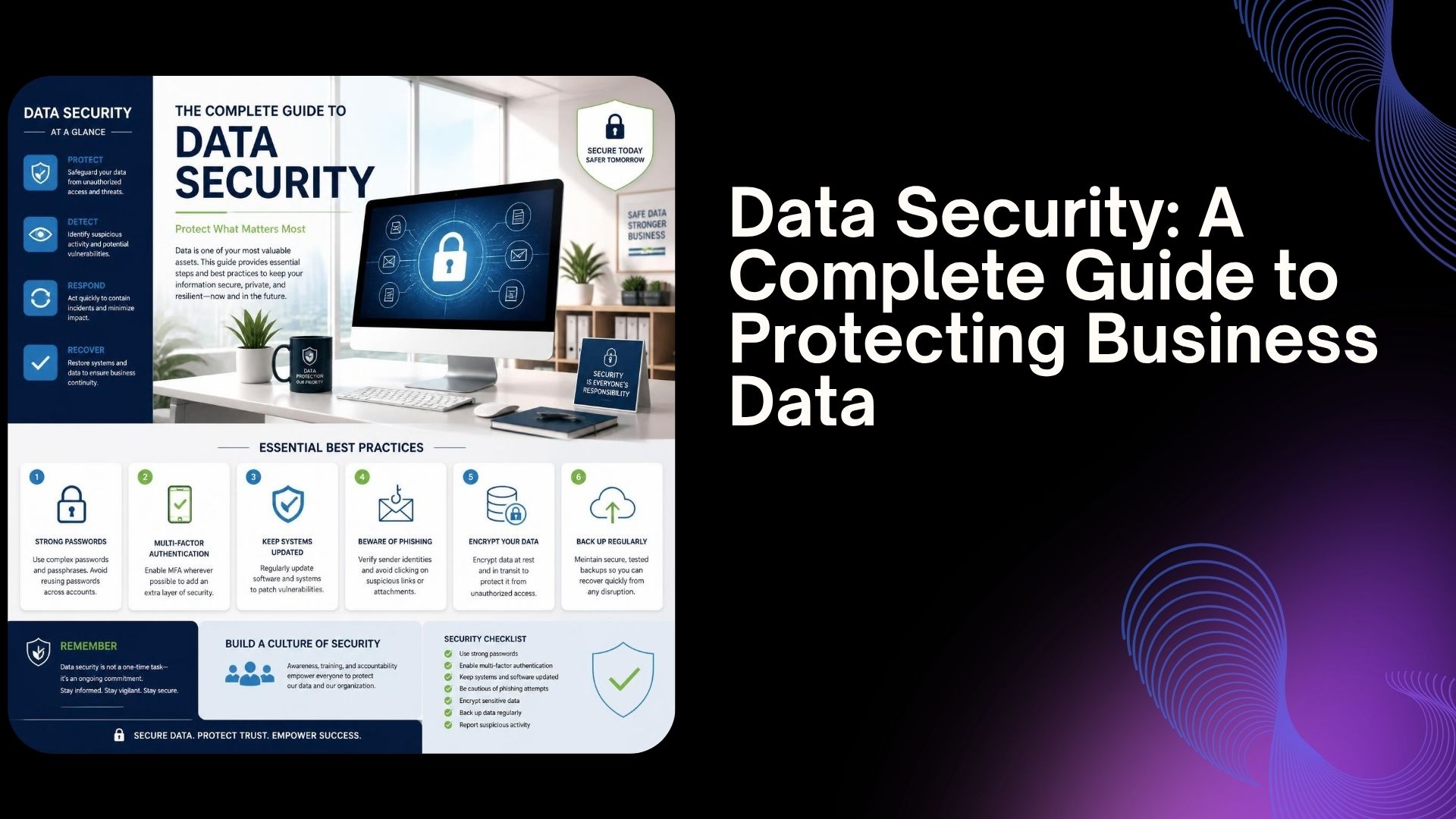
Data Security: A Complete Guide to Protecting Business Data
Data Security: A Complete Guide to Protecting Business Data in 2026
Data Security is no longer only an IT concern. For modern businesses, data is one of the most valuable digital assets they manage. Customer information, financial records, employee data, intellectual property, business documents, application data, and operational information all need protection from unauthorized access, accidental loss, misuse, and cyberattacks.
As organizations increasingly adopt cloud platforms, remote work, SaaS applications, AI tools, and interconnected business systems, the amount of data being created and exchanged continues to grow. This makes a well-planned data security strategy essential for maintaining confidentiality, integrity, availability, and business continuity.
The National Institute of Standards and Technology (NIST) identifies data security as part of broader cybersecurity protection activities and emphasizes controls such as access management, encryption, and regular backups.
But what exactly is data security, what threats do businesses face, and how can organizations build a stronger approach?
What Is Data Security?
Data security refers to the technologies, processes, policies, and controls used to protect data from unauthorized access, alteration, disclosure, destruction, theft, or loss.
It applies throughout the entire data lifecycle—from the moment information is collected and stored to the time it is processed, transferred, archived, or securely deleted.
A comprehensive data security strategy generally focuses on three fundamental objectives:
1. Confidentiality
Confidentiality ensures that sensitive information is accessible only to authorized individuals, systems, or applications.
For example, customer financial information should not be accessible to every employee in an organization. Access should be restricted according to business requirements and responsibilities.
2. Integrity
Data integrity means ensuring that information remains accurate, complete, and protected from unauthorized modification or destruction.
If critical business records are altered without authorization, the organization could make decisions based on incorrect information.
3. Availability
Availability means ensuring that authorized users can access data when they need it.
A ransomware attack, system failure, or infrastructure outage can make critical information unavailable. Therefore, data protection must also include backup, recovery, and business continuity measures.
Why Is Data Security Important for Businesses?
Businesses depend on data for almost every major activity, including customer management, financial operations, sales, marketing, healthcare services, supply chains, analytics, and decision-making.
A data security incident can affect much more than an IT environment. It can interrupt operations, expose confidential information, create regulatory obligations, and damage customer trust.
Modern organizations also operate across multiple environments. Data may exist in:
- On-premises servers
- Cloud infrastructure
- SaaS applications
- Employee devices
- Databases
- Email platforms
- Backup systems
- Data lakes and analytics platforms
- Third-party applications
This distributed environment makes it important for businesses to understand where sensitive data resides, who can access it, how it moves, and how it is protected.
NIST's security and privacy controls emphasize protecting organizational operations, assets, individuals, and information systems against threats including cyberattacks, human errors, natural disasters, and system failures.
Common Data Security Threats Businesses Face
Data can be compromised through both sophisticated cyberattacks and everyday operational mistakes.
Ransomware
Ransomware can prevent organizations from accessing systems and data. Modern ransomware incidents can also involve data theft, where attackers threaten to disclose stolen information.
CISA recommends maintaining protected backups and regularly testing restoration procedures as part of ransomware preparedness.
Phishing and Social Engineering
Attackers may use deceptive emails, messages, websites, or phone calls to convince employees to reveal credentials or provide access to business systems.
Even advanced technical security controls can be undermined if compromised credentials provide attackers with legitimate access.
Insider Risk
Employees, contractors, and third-party users may have access to sensitive information. Insider-related risks can result from malicious activity, compromised accounts, or accidental data exposure.
Unauthorized Access
Weak passwords, excessive permissions, inactive accounts, and poorly managed privileged access can increase the possibility of unauthorized data access.
Cloud Misconfiguration
Cloud environments can contain large amounts of sensitive business information. Incorrect storage permissions, exposed credentials, or overly broad access policies can create unnecessary security risks.
Data Loss
Data can also be lost because of hardware failures, accidental deletion, software problems, natural disasters, or unsuccessful system changes.
This is why data security should not focus only on preventing attacks. It should also address recovery.
Key Data Security Best Practices
A strong data security strategy combines multiple layers of protection rather than relying on a single security product.
1. Discover and Classify Your Data
Organizations should first understand what data they have and where it is stored.
Identify sensitive information such as:
- Customer and personal information
- Financial records
- Intellectual property
- Employee information
- Business-critical documents
- Credentials and authentication information
- Healthcare or other sensitive records
Data classification can help organizations determine which information requires stronger controls.
Understanding how data is collected, processed, transferred, shared, and stored is also an important part of assessing its criticality.
2. Implement Strong Access Controls
Not every employee needs access to every dataset.
Organizations should implement role-based access controls and provide users with only the permissions required for their responsibilities.
NIST recommends unique accounts and limiting access to the information, systems, and applications users actually need.
Organizations should also consider:
- Multi-factor authentication
- Role-based access control
- Privileged access management
- Regular access reviews
- Removal of inactive accounts
- Strong password policies
3. Encrypt Sensitive Data
Encryption transforms readable information into a protected format that requires an appropriate key or mechanism to access.
Businesses should consider protecting data:
- At rest — while stored
- In transit — while being transferred
- During sensitive processing, where applicable
NIST specifically recommends encryption for sensitive data stored on systems and transmitted to other parties.
Cloud providers also commonly use encryption as part of storage protection. Google Cloud, for example, documents encryption of data before it is written to storage systems, alongside access controls for authorized services.
4. Maintain Secure Backups
Backup is a critical component of data security because prevention alone cannot eliminate every risk.
Businesses should maintain reliable copies of critical data and regularly verify that those backups can actually be restored.
For ransomware resilience, CISA recommends maintaining offline, encrypted backups and regularly testing them.
A backup strategy should consider:
- Backup frequency
- Backup retention
- Backup security
- Offline or isolated copies
- Recovery objectives
- Restoration testing
- Disaster recovery procedures
5. Monitor Data Access and Activity
Security teams should understand what is happening across critical systems.
Monitoring can help identify unusual login behavior, unexpected data transfers, suspicious account activity, or unauthorized changes.
Security logs and monitoring tools can provide visibility into activity across endpoints, networks, applications, and cloud environments.
6. Protect Endpoints and Applications
Employee laptops, desktops, mobile devices, applications, and servers can all become entry points to business data.
Organizations should maintain:
- Endpoint security
- Vulnerability management
- Security updates and patches
- Application security
- Email security
- Secure configuration standards
Protecting the systems that interact with data is an essential part of protecting the data itself.
7. Secure Third-Party Access
Businesses often share data with vendors, partners, cloud providers, consultants, and other external organizations.
Before granting third-party access, organizations should understand:
- What data is being shared
- Why it is being shared
- Who can access it
- Where the information is stored
- How it is protected
- How access will be removed
Third-party risk management should therefore form part of an organization's broader data security program.
Data Security in Cloud Environments
Cloud adoption has changed how businesses store and process information.
Instead of keeping all data within traditional data centers, organizations may distribute information across multiple cloud platforms, SaaS applications, databases, and data analytics environments.
Cloud data security therefore requires visibility and appropriate controls across the entire environment.
Businesses should pay attention to:
Identity: Who can access cloud data?
Permissions: What can each user or application do?
Encryption: Is sensitive information protected during storage and transmission?
Configuration: Are cloud services configured securely?
Monitoring: Can suspicious activity be detected?
Backup: Can critical cloud data be recovered after accidental deletion, system failure, or ransomware?
A cloud-first environment does not remove the need for data security. Instead, it changes how security responsibilities must be managed.
Data Security and Data Privacy: Are They the Same?
Data security and data privacy are closely related but are not identical.
Data security focuses primarily on protecting information against unauthorized access, modification, disclosure, destruction, or loss.
Data privacy focuses on how personal information is collected, processed, used, shared, retained, and managed.
An organization can therefore have strong technical security while still needing to address privacy requirements concerning how personal information is handled.
NIST describes privacy risk management as complementary to cybersecurity risk management, rather than treating privacy and cybersecurity as exactly the same discipline.
For businesses, both areas should be considered when developing a comprehensive data protection strategy.
How Businesses Can Build a Data Security Strategy
A practical approach can be organized into five stages:
Step 1: Identify
Discover critical data, systems, users, applications, and data flows.
Step 2: Assess
Identify vulnerabilities, access risks, configuration gaps, third-party risks, and potential business impacts.
Step 3: Protect
Implement appropriate controls such as encryption, access management, MFA, endpoint security, backup, and data protection technologies.
Step 4: Monitor
Continuously monitor systems, users, access patterns, and security events to identify suspicious activity.
Step 5: Recover
Maintain tested backup and recovery procedures so the organization can restore critical operations after an incident.
This risk-based approach aligns with broader NIST guidance, which emphasizes identifying and managing cybersecurity risks and implementing appropriate protection, detection, response, and recovery activities.
How Dhanyaayai Helps Businesses Strengthen Data Security
Data security requires more than deploying a single security tool. Businesses need a structured approach that considers their infrastructure, applications, data, users, cloud environment, and recovery requirements.
Dhanyaayai helps organizations strengthen their broader cybersecurity and data protection approach by combining technology, security practices, and business-focused solutions.
Our approach can support organizations in areas such as:
- Data protection and security strategy
- Cybersecurity assessment and risk management
- Cloud and infrastructure security
- Backup and data resiliency
- Security monitoring and protection
- Business continuity and recovery planning
- Protection of business-critical information
For organizations managing data across cloud, on-premises, and hybrid environments, the objective is to create greater visibility into where critical information exists and establish appropriate controls around it.
Data security also works closely with data resiliency. Protecting information from unauthorized access is one side of the equation; ensuring that critical information can be recovered after an incident is another.
By bringing security, backup, recovery, and infrastructure considerations together, organizations can develop a more comprehensive approach to protecting business-critical data.
Final Thoughts
Data Security is a continuous business responsibility rather than a one-time technology project.
As businesses expand their use of cloud platforms, SaaS applications, AI, analytics, remote work, and connected systems, their data environments become increasingly distributed. This makes it important to understand where sensitive information resides, who can access it, how it moves, and how it can be protected and recovered.
A strong strategy should combine data discovery, access control, encryption, monitoring, endpoint protection, secure backups, recovery planning, and employee awareness.
The goal is not simply to prevent a data breach. It is to build an environment where business data remains confidential, accurate, available, and recoverable throughout its lifecycle.
If your organization is reviewing its cybersecurity, cloud security, backup, or data protection strategy, Dhanyaayai can help you identify the right areas to strengthen based on your business environment and requirements.