Data Resiliency Solutions: How Businesses Can Protect Data, Ensure Continuity, and Recover Faster
Cyberattacks, ransomware, accidental deletion, hardware failures, cloud outages, software errors, and natural disasters can disrupt access to critical information within minutes. A traditional backup strategy may not be enough to keep a business running when a major disruption occurs.
This is where Data Resiliency Solutions become important.
Data resiliency is the ability of an organization to protect its data, maintain access to critical information during disruptions, and recover systems and data quickly when something goes wrong. Rather than focusing only on backup, a resilient data strategy combines data protection, recovery, redundancy, monitoring, security, and business continuity.
For businesses operating across hybrid, cloud, and on-premises environments, data resiliency is becoming an essential part of IT and cybersecurity strategy.
What Are Data Resiliency Solutions?
Data Resiliency Solutions are technologies, processes, and strategies designed to keep business data protected, available, recoverable, and usable during unexpected disruptions.
A resilient data environment typically addresses four important questions:
-
How is critical data protected?
-
How quickly can data be recovered?
-
Can the organization continue operating during an outage?
-
Can backup and recovery systems themselves be protected from cyberattacks?
This makes data resiliency broader than conventional backup.
For example, an organization may have daily backups but still experience significant business disruption if restoring those backups takes several days. A resilient approach considers recovery objectives, multiple copies of data, isolated backups, automated recovery, workload dependencies, and ongoing testing.
Why Data Resiliency Matters for Modern Businesses
Businesses today rarely operate from a single physical location or infrastructure environment. Applications and data may be distributed across data centers, private clouds, public clouds, SaaS applications, remote endpoints, and employee devices.
This distributed environment creates additional risks.
A ransomware attack can encrypt production systems and attempt to compromise connected backups. An employee may accidentally delete important files. A cloud service interruption can make business applications temporarily unavailable. A database failure can affect customer transactions and internal operations.
Without a resilient recovery strategy, organizations may face:
- Financial losses: Downtime can stop transactions, delay operations, and increase recovery costs.
- Customer disruption: Customers expect digital services to remain available and responsive.
- Reputational damage: Extended outages can reduce customer confidence.
- Compliance challenges: Organizations may need to demonstrate that sensitive information is appropriately protected and recoverable.
- Operational disruption: Employees may be unable to access the applications and information required to perform their jobs.
Data resiliency helps organizations move from simply protecting data to maintaining business continuity.
Data Backup vs. Data Resiliency
Backup remains an important component of data protection, but backup alone does not guarantee resilience.
Consider a company that performs one backup every night. If ransomware compromises the environment before the next backup, recent information could be lost. If the backup repository is connected to the same environment, attackers may also attempt to compromise it.
A data resiliency strategy takes a broader approach.
It can include multiple copies of important information, geographically separated recovery resources, immutable or isolated backups, continuous monitoring, automated recovery processes, and regular recovery testing.
The objective is not simply to have a copy of the data.
The objective is to recover the business when the original environment is unavailable or compromised.
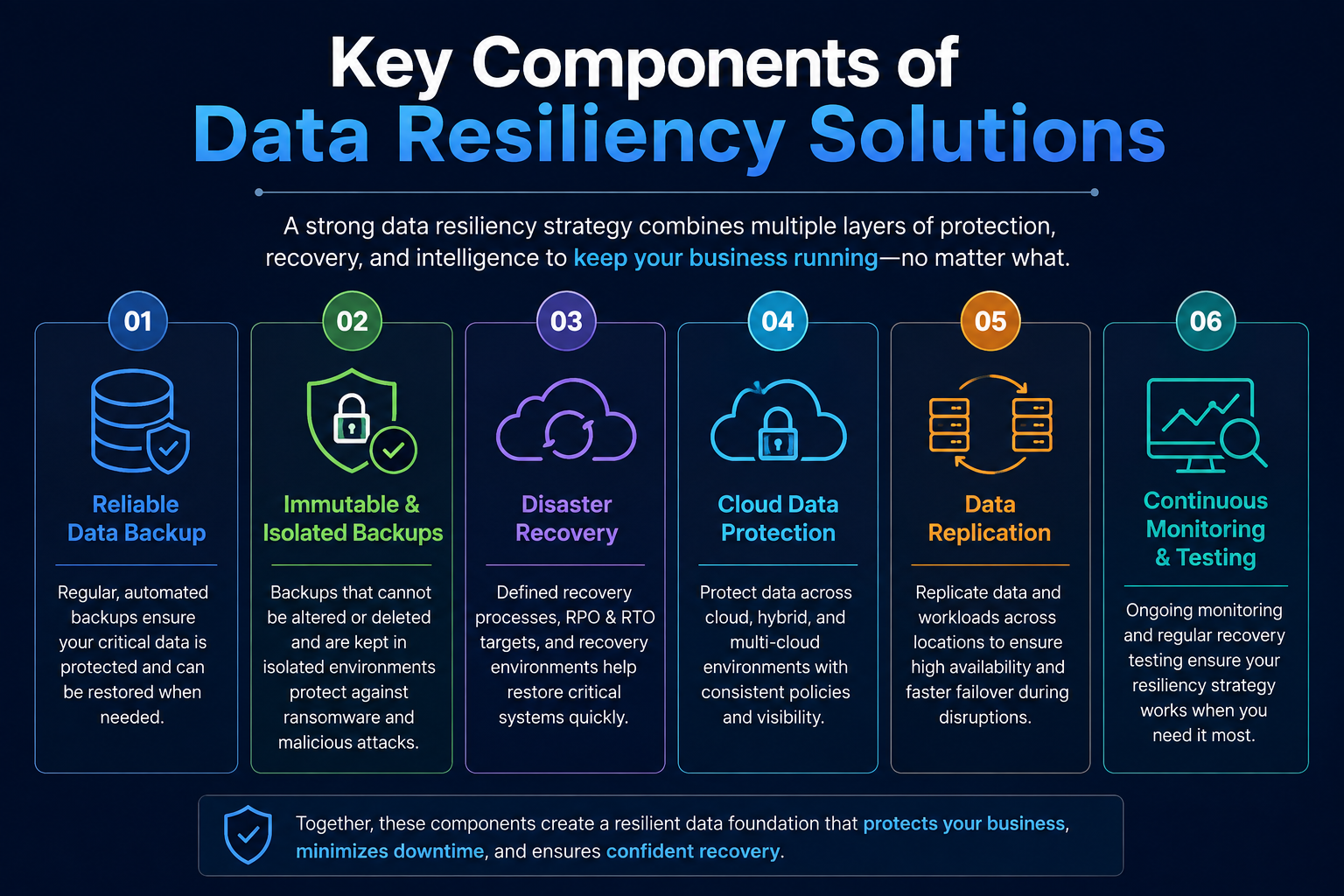
Key Components of Data Resiliency Solutions
1. Reliable Data Backup
A strong resiliency strategy begins with dependable backups.
Organizations should identify which data is business-critical and determine how frequently it needs to be protected. Mission-critical databases may require more frequent protection than less important archival information.
Backup policies should also consider retention requirements, recovery priorities, and different infrastructure environments.
2. Immutable and Isolated Backups
Modern cyber threats have made backup security increasingly important.
Attackers may attempt to delete or encrypt backups after compromising production systems. Immutable backups are designed so that protected recovery points cannot easily be altered or deleted during their retention period.
Organizations can also use isolated recovery environments to reduce the risk of an attack spreading from production infrastructure to backup systems.
3. Disaster Recovery
Disaster recovery focuses on restoring technology and applications following major disruptions.
A resilient disaster recovery strategy identifies critical applications, their dependencies, recovery priorities, and acceptable downtime.
Two important concepts are Recovery Time Objective (RTO) and Recovery Point Objective (RPO).
RTO defines how quickly a service should be restored, while RPO defines how much data loss, measured in time, an organization can tolerate.
For example, an application with a 30-minute RPO may need data protection that allows recovery to a point no more than 30 minutes before an incident.
4. Cloud Data Protection
Cloud adoption has changed how organizations manage data.
Businesses may use multiple cloud platforms while maintaining on-premises infrastructure and SaaS applications. This creates a need for consistent protection across different environments.
Cloud data resiliency can include backup of cloud workloads, cross-region recovery, replication, centralized monitoring, and recovery testing.
5. Data Replication
Replication creates additional copies of data or workloads that can be used when the primary environment becomes unavailable.
For critical applications, replication can significantly reduce recovery time because organizations may be able to switch operations to a secondary environment rather than rebuilding everything from scratch.
6. Continuous Monitoring and Testing
A recovery plan is only valuable if it works when needed.
Organizations should regularly test backups, recovery procedures, application dependencies, and disaster recovery environments.
Monitoring can also help identify failed backups, unusual data activity, storage issues, and potential threats before they become major problems.
Real-World Use Case: Protecting a Financial Services Company
Imagine a financial services company that processes thousands of customer transactions every day.
Its primary database becomes unavailable after a ransomware attack. The attackers also attempt to compromise connected backup infrastructure.
Without a resilient architecture, the company could spend days rebuilding systems and restoring information. During this period, customers may experience service interruptions and employees may be unable to access critical applications.
With Data Resiliency Solutions in place, the organization could have:
-
Protected and immutable recovery points
-
Isolated backup infrastructure
-
Replicated critical workloads
-
Clearly defined RPO and RTO targets
-
Automated recovery procedures
-
Regular recovery testing
After the attack is contained, the company can restore clean data and critical workloads from trusted recovery points.
The key advantage is not simply having backups. It is having trusted recovery options that remain available when production systems are compromised.
Use Case: Healthcare Data Protection
Healthcare organizations manage highly sensitive patient and operational information.
Consider a hospital whose patient management application becomes unavailable because of infrastructure failure or cyberattack. Doctors and administrative teams may struggle to access critical information, potentially affecting hospital operations.
A resilient architecture can provide protected backups, replicated workloads, rapid recovery capabilities, and recovery priorities for critical applications.
For example, patient-facing applications could receive higher recovery priority than non-critical internal systems.
This approach allows the organization to focus recovery resources where they have the greatest operational impact.
Use Case: Manufacturing and Supply Chain Continuity
Manufacturing companies increasingly depend on digital systems for production planning, inventory management, logistics, and supplier coordination.
Suppose a manufacturing company experiences a major server failure that affects its enterprise resource planning system. Production schedules, inventory information, and supplier data become inaccessible.
With a resilient data strategy, the organization can recover critical workloads from a secondary environment and restore essential operations while the primary infrastructure is repaired.
This reduces downtime and helps prevent a technology failure from becoming a larger supply chain disruption.
How Businesses Can Build a Strong Data Resiliency Strategy
Creating resilience starts with understanding what needs to be protected.
Identify Critical Data and Applications
Not every workload has the same business value.
Organizations should classify data and applications according to business importance, sensitivity, recovery requirements, and regulatory obligations.
Define RPO and RTO
Recovery targets should be established before an incident occurs.
Critical applications may require near-continuous protection and rapid recovery, while less critical systems may have longer recovery windows.
Follow a Multi-Layered Protection Strategy
Organizations should avoid relying on a single backup location or technology.
A stronger strategy combines multiple recovery mechanisms, such as backup, replication, immutable storage, and isolated recovery environments.
Protect the Recovery Infrastructure
Backup environments should receive the same level of security attention as production systems.
Access controls, authentication, encryption, monitoring, and network segmentation can help reduce unauthorized access to recovery resources.
Test Recovery Regularly
A backup that has never been successfully restored should not be treated as a guaranteed recovery solution.
Regular recovery testing helps organizations discover configuration problems, missing dependencies, outdated procedures, and recovery bottlenecks.
The Role of Data Resiliency in Cybersecurity
Data resiliency and cybersecurity are becoming increasingly connected.
Security controls attempt to prevent attacks, detect suspicious activity, and contain threats. Data resiliency provides a recovery layer when prevention and detection controls are bypassed.
This is especially important in ransomware scenarios.
A business may have endpoint security, network security, identity controls, and threat detection. However, if an attacker still manages to compromise critical systems, resilient recovery capabilities can help reduce the impact.
This creates a broader security model:
Prevent → Detect → Respond → Recover
Data resiliency strengthens the final stage: recovery.
How Dhanyaayai Can Help Businesses Strengthen Data Resiliency
Building a resilient data environment can become complex when organizations operate across cloud, on-premises, hybrid, and distributed environments.
Dhanyaayai helps businesses address modern technology and data protection requirements through solutions focused on data resiliency, cloud computing and networking, cybersecurity, and data and AI capabilities.
A practical resiliency strategy can bring together secure data protection, backup and recovery, cloud infrastructure, cybersecurity controls, monitoring, and business continuity requirements.
Instead of treating backup, security, and recovery as completely separate functions, businesses can build a more integrated approach that supports both operational continuity and cyber resilience.
The right solution also depends on an organization's infrastructure, workload criticality, compliance requirements, recovery objectives, and growth plans.
The Future of Data Resiliency
Data environments will continue to become more distributed and complex.
Organizations are adopting cloud platforms, AI applications, remote infrastructure, SaaS services, and increasingly interconnected digital systems. At the same time, cyber threats are becoming more sophisticated.
As a result, businesses will need to think beyond traditional backup strategies.
Future-ready data resiliency will increasingly involve automation, intelligent monitoring, immutable recovery points, hybrid-cloud protection, rapid recovery orchestration, and stronger integration between cybersecurity and data protection.
The goal is simple: when disruption occurs, businesses should be able to recover confidently instead of reacting under pressure.
Conclusion
Data is too important to leave recovery to chance.
Data Resiliency Solutions help organizations protect critical information, reduce downtime, recover from cyber incidents, and maintain business continuity when unexpected disruptions occur.
From ransomware attacks and infrastructure failures to cloud outages and accidental data loss, resilient organizations are better prepared to respond because they have already planned how recovery will work.
A strong strategy goes beyond creating backups. It combines secure protection, redundancy, recovery planning, monitoring, testing, and cybersecurity to create a dependable recovery foundation.
For businesses looking to improve operational continuity and strengthen their overall cyber resilience, investing in a modern data resiliency strategy can turn data protection from a reactive IT function into a strategic business capability.
Frequently Asked Questions
1. What are Data Resiliency Solutions?
Data Resiliency Solutions are technologies and strategies that help organizations protect, maintain, and recover critical data and applications during cyberattacks, outages, hardware failures, accidental deletion, and other disruptions.
2. How is data resiliency different from backup?
Backup creates copies of data, while data resiliency takes a broader approach that includes backup, replication, disaster recovery, security, monitoring, recovery testing, and business continuity.
3. Why is data resiliency important for ransomware protection?
Ransomware can affect both production systems and connected backup infrastructure. Immutable, isolated, and properly secured recovery copies can provide organizations with trusted options for restoring affected systems.
4. What are RPO and RTO in data resiliency?
RPO defines the amount of data loss an organization can tolerate, while RTO defines the maximum acceptable time required to restore a service or application.
5. Can Data Resiliency Solutions support cloud and hybrid environments?
Yes. Modern data resiliency strategies can protect workloads across on-premises infrastructure, private clouds, public clouds, and hybrid environments while providing centralized protection and recovery capabilities.