Endpoint Detection and Response (EDR): A Complete Guide for Modern Businesses
Cyberattacks are becoming faster, more sophisticated, and increasingly difficult to identify with traditional antivirus and endpoint protection tools. Attackers no longer rely only on obvious malware. They use stolen credentials, legitimate system tools, fileless techniques, lateral movement, ransomware, and other methods designed to blend into normal business activity. This is where CrowdStrike EDR becomes an important part of a modern cybersecurity strategy.
CrowdStrike's endpoint detection and response capabilities are designed to continuously monitor endpoint activity, identify suspicious behavior, investigate threats, and help security teams respond quickly. Its Falcon platform combines endpoint telemetry, behavioral analytics, threat intelligence, artificial intelligence, and response capabilities to provide security teams with greater visibility into attacks.
For organizations managing laptops, desktops, servers, cloud workloads, and remote endpoints, EDR can provide an additional layer of protection against threats that traditional antivirus may not detect.
In this guide, we will explore what CrowdStrike EDR is, how it works, its key capabilities, benefits, real-world use cases, and why businesses should consider it as part of their endpoint security strategy.
What Is EDR?
EDR (Endpoint Detection and Response) is a security capability within the CrowdStrike Falcon platform that helps organizations continuously monitor endpoint activity to detect, investigate, and respond to cyber threats.
Unlike traditional antivirus solutions that primarily focus on identifying known malicious files, EDR looks at what is happening across an endpoint. It can analyze processes, user activity, system behavior, and other security telemetry to identify suspicious patterns.
CrowdStrike's Falcon Insight XDR provides AI-powered endpoint detection and response supported by threat intelligence and broader security context. CrowdStrike describes its approach as combining behavioral detection, adversary intelligence, and response capabilities to help security teams identify sophisticated attacks.
The key idea is simple: don't just ask whether a file is malicious; understand what the attacker is doing.
For example, an employee device may execute PowerShell, create a new process, access credentials, and communicate with an unusual external system. Individually, some of these activities may appear legitimate. When analyzed together, however, they could indicate an attack.
EDR helps security teams connect these activities and investigate the broader attack story.
Why Traditional Endpoint Security Is No Longer Enough
Traditional antivirus remains useful, but modern attacks increasingly exploit legitimate tools and trusted applications.
Attackers may use:
-
Stolen usernames and passwords
-
PowerShell and command-line tools
-
Remote access applications
-
Credential theft
-
Malicious scripts
-
Fileless techniques
-
Ransomware
-
Lateral movement
-
Living-off-the-land techniques
This makes signature-based detection alone insufficient for many modern environments.
Consider a ransomware attack. The attacker may initially gain access through a phishing email or compromised credentials. After entering the environment, they may attempt to disable security controls, move between systems, obtain additional credentials, and eventually encrypt business-critical files.
An endpoint security platform needs to identify more than the final ransomware payload. It needs to recognize suspicious behavior during the attack lifecycle.
This is one of the primary reasons organizations adopt EDR.
How EDR Works
CrowdStrike EDR works by collecting and analyzing endpoint activities to provide security teams with visibility into potentially malicious behavior.
1. Continuous Endpoint Monitoring
The first step is visibility.
Endpoints generate enormous amounts of activity every day. Applications start and stop, users log in, processes communicate with other systems, files are accessed, and commands are executed.
CrowdStrike Falcon continuously monitors endpoint activity and uses telemetry to help security teams identify suspicious behavior.
Instead of looking at a single event in isolation, EDR can evaluate sequences of activities to determine whether they represent an attack.
2. Behavioral Threat Detection
Modern attackers frequently modify malware or use legitimate tools to avoid traditional signatures.
Behavioral detection focuses on what an attacker is doing.
For example, an endpoint suddenly displaying a sequence such as:
Office application → Script execution → Credential access → Remote connection → File modification
could represent suspicious activity.
CrowdStrike uses indicators of attack and behavioral analytics to identify attacker activity rather than depending only on traditional malware signatures.
3. Threat Intelligence
Detection becomes more powerful when endpoint activity is combined with threat intelligence.
CrowdStrike's EDR capabilities are enriched with adversary intelligence that can provide context for attacker tactics, techniques, and procedures.
This helps security analysts understand questions such as:
-
What type of attack is taking place?
-
Which attacker behavior is being observed?
-
What systems could be affected?
-
Is the activity associated with known adversary techniques?
-
What should the security team investigate next?
The result is a more contextual approach to threat detection rather than a simple alert-generation process.
4. Investigation
Detecting a suspicious event is only the beginning.
Security teams must determine whether the activity is malicious, understand the attack path, identify affected endpoints, and determine what actions are required.
CrowdStrike Falcon provides investigation capabilities designed to help analysts examine attack activity and understand relationships between events. Falcon Insight XDR also provides broader visibility across security domains and supports AI-assisted investigations.
This can reduce the time analysts spend manually piecing together information from multiple security tools.
5. Response and Remediation
Once a threat is confirmed, organizations need to contain it quickly.
CrowdStrike provides response capabilities such as Real Time Response and automated remediation. These capabilities can help security teams investigate systems, remove threats, and perform response actions without relying entirely on manual endpoint intervention.
For a large enterprise, this can be particularly important. If hundreds or thousands of endpoints are potentially affected, manually responding to every machine can significantly delay containment.
Key Features of EDR
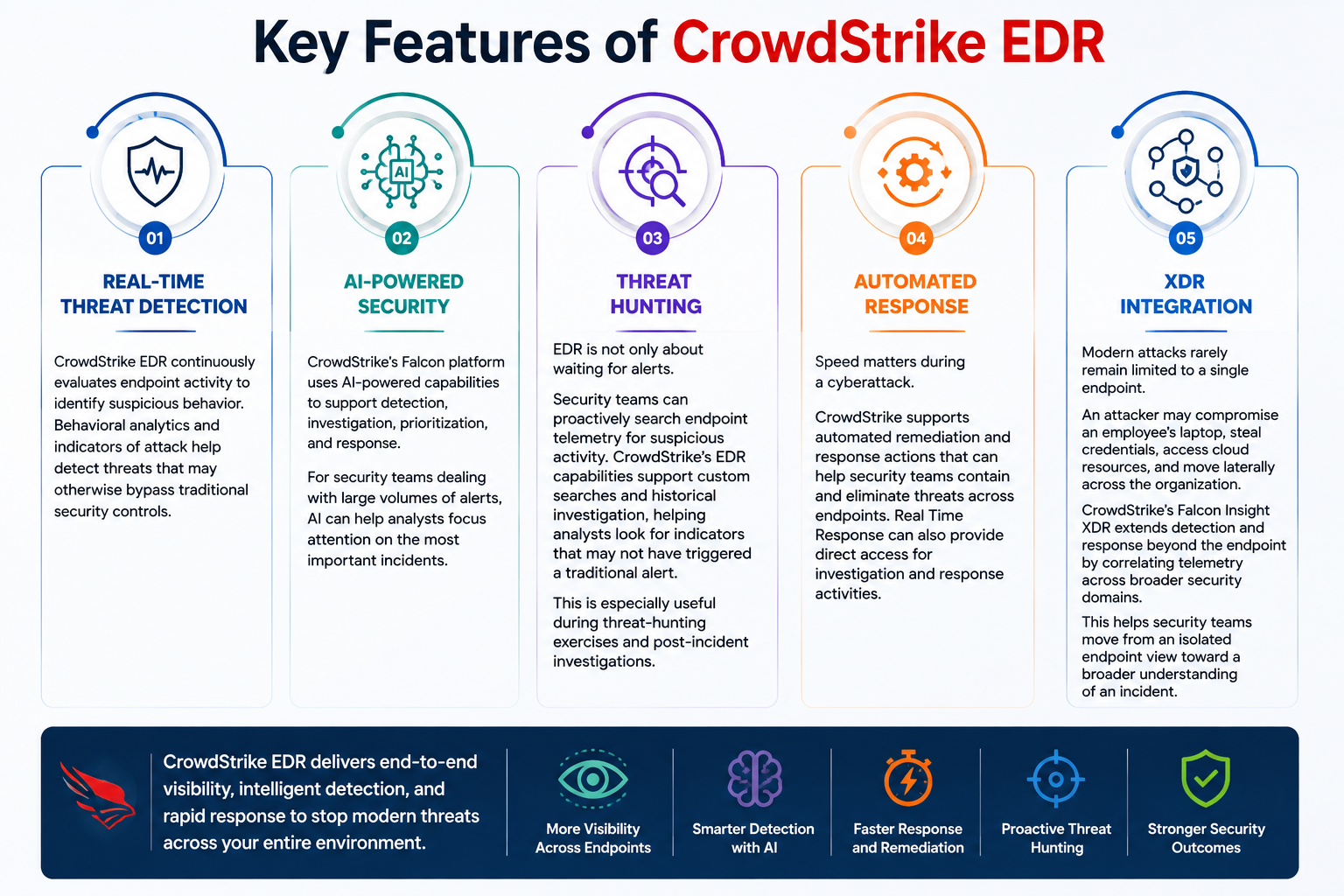
Real-Time Threat Detection
CrowdStrike EDR continuously evaluates endpoint activity to identify suspicious behavior. Behavioral analytics and indicators of attack help detect threats that may otherwise bypass traditional security controls.
AI-Powered Security
Artificial intelligence is increasingly becoming an important component of security operations.
CrowdStrike's Falcon platform uses AI-powered capabilities to support detection, investigation, prioritization, and response. Its current platform strategy also extends security capabilities toward emerging AI-related risks across endpoints, SaaS, browsers, and cloud environments.
For security teams dealing with large volumes of alerts, AI can help analysts focus attention on the most important incidents.
Threat Hunting
EDR is not only about waiting for alerts.
Security teams can proactively search endpoint telemetry for suspicious activity. CrowdStrike's EDR capabilities support custom searches and historical investigation, helping analysts look for indicators that may not have triggered a traditional alert.
This is especially useful during threat-hunting exercises and post-incident investigations.
Automated Response
Speed matters during a cyberattack.
CrowdStrike supports automated remediation and response actions that can help security teams contain and eliminate threats across endpoints. Real Time Response can also provide direct access for investigation and response activities.
XDR Integration
Modern attacks rarely remain limited to a single endpoint.
An attacker may compromise an employee's laptop, steal credentials, access cloud resources, and move laterally across the organization.
CrowdStrike's Falcon Insight XDR extends detection and response beyond the endpoint by correlating telemetry across broader security domains.
This helps security teams move from an isolated endpoint view toward a broader understanding of an incident.
EDR vs Traditional Antivirus
The biggest difference between antivirus and EDR is the depth of visibility and response.
Traditional antivirus generally focuses on preventing or detecting malicious files and known threats. EDR adds continuous monitoring, behavioral analysis, investigation, threat hunting, and response capabilities.
For example:
Traditional antivirus:
"Is this file known to be malicious?"
EDR:
"What is this process doing, what happened before it executed, what other systems did it interact with, and does the sequence indicate an attack?"
This distinction becomes important when attackers use legitimate applications, stolen credentials, scripts, and previously unknown techniques.
EDR does not necessarily replace every other security technology. Instead, it can become a central component of an organization's endpoint detection and incident response strategy.
Benefits of EDR for Businesses
1. Faster Threat Detection
Continuous monitoring and behavioral analysis can help security teams identify suspicious activity earlier.
Early detection is critical because attackers can move from initial access to lateral movement and data theft before organizations realize that a breach has occurred.
2. Better Visibility
Without endpoint visibility, security teams may only see the consequences of an attack.
EDR provides detailed endpoint telemetry that can help analysts understand what happened before, during, and after a suspicious event.
3. Faster Incident Response
The longer an attacker remains inside an environment, the greater the potential damage.
Response capabilities can help organizations isolate, investigate, and remediate affected systems more quickly.
4. Reduced Security Complexity
Security teams often work with multiple disconnected tools.
CrowdStrike's Falcon platform is designed to bring endpoint security, detection, investigation, and broader XDR capabilities together within a unified platform.
This can help security teams reduce the time spent switching between different consoles and manually correlating information.
5. Stronger Ransomware Defense
Ransomware continues to be a major business risk.
A modern EDR solution can look for suspicious behaviors associated with ransomware activity rather than waiting until files have already been encrypted.
CrowdStrike highlights ransomware protection, automated remediation, and behavioral detection as components of its endpoint security approach.
Real-World Use Case: Stopping a Ransomware Attack
Imagine a mid-sized financial services organization with 1,000 employees.
An employee receives a convincing phishing email and opens a malicious document. The attacker attempts to execute a script, obtain credentials, establish persistence, and move toward file servers.
A traditional security solution might identify the malicious file, but the attacker could potentially use legitimate system utilities during later stages of the attack.
With EDR, the security team can investigate the sequence of endpoint events.
The system may identify suspicious script execution, unusual process behavior, credential access attempts, and other indicators that collectively suggest malicious activity.
The security team can then investigate the affected endpoint, determine whether other machines are involved, contain the threat, and perform remediation.
This illustrates an important principle of EDR: the objective is not simply to detect malware; it is to understand and disrupt the attack.
EDR in the Age of AI
The security landscape is changing as organizations rapidly adopt generative AI and AI agents.
AI applications can access business data, execute actions, interact with systems, and operate directly from employee endpoints. This creates new security challenges.
CrowdStrike announced in 2026 that it was extending its Falcon platform to address AI-related risks across endpoints, SaaS, browsers, and cloud environments. The company has also introduced AI Detection and Response capabilities focused on protecting AI interactions and AI agents.
This highlights an important shift in endpoint security.
The endpoint is no longer simple where employees run applications. It can also become the location where AI agents execute commands, access sensitive information, and interact with enterprise systems.
For businesses adopting AI at scale, endpoint visibility will therefore become increasingly important.
How Businesses Can Get More Value from CrowdStrike EDR
Technology cannot create a complete security strategy.
Organizations should combine EDR with strong security processes.
Start by identifying all endpoints that need protection, including remote devices, servers, and critical business systems.
Next, define clear incident-response procedures. Security teams should know what happens when a high-severity detection occurs, who investigates it, who approves containment actions, and how recovery is handled.
Organizations should also regularly review detection policies, investigate suspicious behavior, conduct threat-hunting exercises, and measure response performance.
Most importantly, EDR should be integrated into the broader cybersecurity strategy rather than treated as an isolated product.
Why EDR Matters in Modern Cybersecurity
Cybersecurity is moving from prevention-only strategies toward continuous detection and response.
Attackers are becoming better at bypassing traditional defenses, while organizations are managing increasingly distributed environments involving remote workers, cloud workloads, SaaS applications, mobile devices, and AI-powered tools.
In this environment, knowing that an endpoint is protected is not enough.
Organizations need to know:
What is happening?
Is the activity suspicious?
What is the attacker trying to achieve?
Which systems are affected by?
How quickly can we contain the threat?
This is the role that EDR is designed to support.
CrowdStrike's approach combines endpoint visibility, behavioral detection, threat intelligence, AI-assisted investigation, threat hunting, and response capabilities. Its Falcon platform also extends beyond endpoint detection through XDR capabilities, helping organizations investigate threats across broader security environments.
How Dhanyaayai Can Help Businesses Strengthen Endpoint Security
Implementing an enterprise-grade EDR solution requires more than deploying an endpoint agent.
Businesses need the right security architecture, deployment strategy, monitoring processes, incident-response workflows, and ongoing security optimization.
At Dhanyaayai, we help organizations evaluate and strengthen their cybersecurity environments by aligning security technologies with business requirements and risk priorities.
Whether your organization is looking to improve endpoint visibility, strengthen threat detection, enhance incident response, or build a more resilient cybersecurity strategy, choosing the right combination of technologies and security expertise is critical.
CrowdStrike EDR can be an important component of that strategy, particularly for organizations that need continuous endpoint visibility and faster detection and response against modern threats.
Final Thoughts
The modern threat landscape requires businesses to think beyond traditional antivirus.
CrowdStrike EDR provides organizations with a more comprehensive approach to endpoint security by combining continuous monitoring, behavioral detection, threat intelligence, investigation, threat hunting, and response.
Its value becomes especially clear when an attacker attempts to operate quietly inside an environment. Instead of waiting for obvious malware to appear, EDR helps security teams identify suspicious behavior and understand the broader attack sequence.
As organizations adopt cloud technologies, remote work, and AI-powered applications, endpoints will continue to play a critical role in enterprise security.
The organizations best prepared for the next generation of cyber threats will not simply focus on preventing attacks. They will build the ability to detect, investigate, contain, and respond to threats quickly.
That is why EDR should be an essential consideration for any modern enterprise cybersecurity strategy.
Is your organization prepared to detect and respond to sophisticated endpoint threats?
Connect with Dhanyaayai to explore how modern endpoint security, EDR, threat detection, and response strategies can help strengthen your organization's cybersecurity posture.
Protect your endpoints. Detect threats faster. Respond with confidence.
Frequently Asked Questions
1. What is CrowdStrike EDR?
CrowdStrike EDR is an endpoint detection and response capability within the CrowdStrike Falcon platform. It continuously monitors endpoint activity and uses behavioral analytics, threat intelligence, and other security capabilities to help organizations detect, investigate, and respond to cyber threats.
2. How is CrowdStrike EDR different from antivirus?
Antivirus primarily focuses on preventing and detecting malicious files and known threats. EDR provides deeper visibility into endpoint activity and adds behavioral detection, investigation, threat hunting, and response capabilities.
3. Can CrowdStrike EDR help with ransomware?
Yes. EDR can help identify suspicious behaviors associated with ransomware attacks and provide response and remediation capabilities. CrowdStrike's endpoint security platform specifically includes ransomware protection and automated remediation capabilities.
4. Is CrowdStrike EDR suitable for large enterprises?
CrowdStrike's Falcon platform is designed for enterprise environments and supports endpoint monitoring, investigation, response, automation, and broader XDR capabilities. Its API capabilities can also support security automation and integration with SIEM, SOAR, and data platforms.
5. Why is EDR important for businesses in 2026?
Businesses are managing increasingly complex environments involving remote endpoints, cloud services, SaaS applications, and AI-powered technologies. EDR provides continuous endpoint visibility and detection and response capabilities that can help organizations identify and contain threats before they cause greater damage.