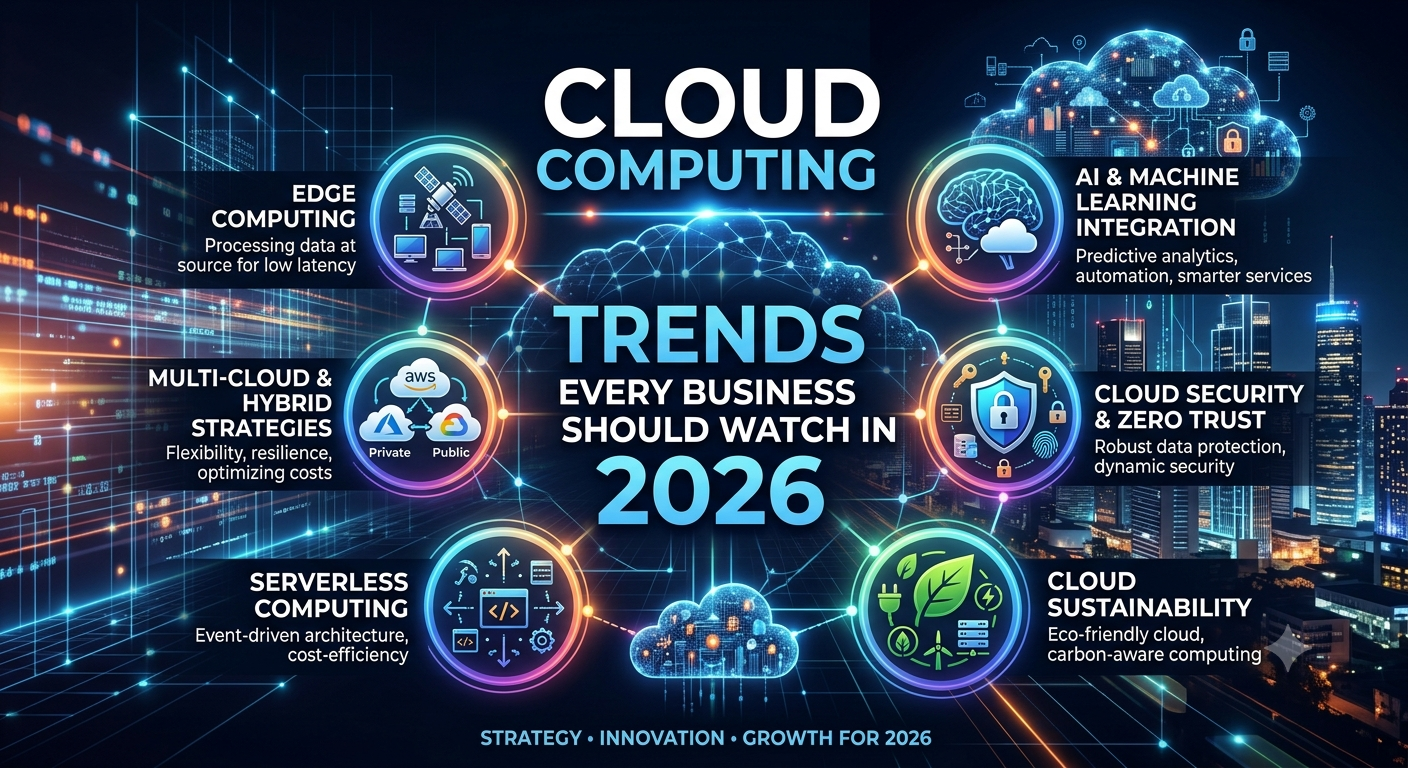
Cloud Computing Trends Every Business Should Watch in 2026
Cloud computing is no longer just an IT investment; it has become the foundation of modern business transformation. From startups to global enterprises, organizations are relying on cloud technologies to innovate faster, improve customer experiences, strengthen cybersecurity, and reduce operational costs. As digital transformation accelerates across industries, cloud computing continues to evolve beyond simple infrastructure, hosting into an intelligent ecosystem powered by artificial intelligence, automation, edge computing, and sustainable technologies.
In 2026, businesses are facing increasing pressure to deliver services faster, protect sensitive data, comply with evolving regulations, and support hybrid workforces. Traditional on-premises infrastructure often struggles to meet these expectations, making cloud adoption a strategic necessity rather than an optional upgrade.
However, simply moving workloads to the cloud is no longer enough. Organizations must understand the latest cloud computing trends, shaping the future of business. Companies that embrace these innovations will be better equipped to remain competitive, improve operational efficiency, and build resilient digital infrastructures.
This article explores the most significant cloud computing trends businesses should watch in 2026 and explains how organizations can prepare for the next generation of cloud transformation.
Why Cloud Computing Continues to Evolve
Over the last decade, cloud computing has transformed from a cost-saving solution into a business enabler. Organizations now expect their cloud platforms to deliver scalability, security, intelligence, and seamless integration across multiple environments.
Several factors are driving this evolution:
- Growing adoption of AI-powered applications
- Increased cybersecurity threats
- Rising demand for real-time analytics
- Expansion of remote and hybrid work
- Regulatory compliance requirements
- Business demand for faster innovation
These challenges encourage organizations to rethink their cloud strategies and invest in more flexible, secure, and intelligent cloud ecosystems.
Hybrid and Multi-Cloud Strategies Become the Standard
The era of relying on a single cloud provider is gradually fading. In 2026, many organizations are adopting hybrid cloud and multi-cloud architectures to improve flexibility, resilience, and business continuity.
Hybrid cloud combines private infrastructure with public cloud services, while multi-cloud involves using services from multiple cloud providers. This approach allows businesses to select the best platform for different workloads while reducing vendor lock-in.
For example, an organization may store sensitive customer information in a private cloud while running customer-facing applications on a public cloud for greater scalability.
The benefits include:
- Better disaster recovery
- Increased application availability
- Improved compliance management
- Enhanced workload optimization
- Greater negotiating power with cloud providers
Organizations that design cloud environments with flexibility in mind will be better prepared for changing business requirements.
Artificial Intelligence Is Becoming Native to Cloud Platforms
Artificial intelligence is no longer an add-on capability. Modern cloud platforms are embedding AI into nearly every service they offer.
Businesses are using AI-powered cloud services to automate repetitive tasks, predict equipment failures, improve customer support, detect fraud, generate insights from business data, and enhance decision-making.
Instead of building AI infrastructure from scratch, organizations can leverage cloud-based AI services that offer:
- Machine learning platforms
- Natural language processing
- Computer vision
- Predictive analytics
- Intelligent automation
- Generative AI services
This significantly reduces development costs while enabling businesses to deploy AI applications much faster.
As AI workloads continue to increase, cloud providers are investing heavily in specialized infrastructure capable of handling complex models efficiently.
Cloud Security Moves Beyond Traditional Protection
Cybersecurity remains one of the biggest concerns for cloud adoption. In 2026, businesses recognize that securing cloud environments requires much more than firewalls and antivirus software.
Organizations are adopting modern cloud security strategies that focus on continuous monitoring, identity management, Zero Trust principles, encryption, and AI-driven threat detection.
Cloud security is becoming more proactive than reactive.
Businesses are increasingly investing in:
- Zero Trust Architecture
- Identity and Access Management (IAM)
- Cloud Security Posture Management (CSPM)
- Extended Detection and Response (XDR)
- Multi-factor authentication
- Continuous compliance monitoring
As ransomware and sophisticated cyberattacks continue to evolve, cloud security will remain a top investment priority across every industry.
Edge Computing Expands Alongside Cloud Computing
Not every application can afford delays caused by sending data to centralized cloud data centers.
Edge computing addresses this challenge by processing data closer to where it is generated.
Industries such as manufacturing, healthcare, logistics, retail, telecommunications, and smart cities increasingly depend on edge computing to process information in real time.
Examples include:
- Autonomous vehicles
- Industrial IoT sensors
- Smart surveillance systems
- Connected healthcare devices
- Retail inventory automation
Cloud computing and edge computing are no longer competing technologies they are complementary. Businesses are building distributed architectures where edge devices handle immediate processing while cloud platforms provide centralized analytics and long-term storage.
Cloud Cost Optimization Becomes a Business Priority
Many organizations have discovered that cloud spending can quickly grow beyond expectations if resources are not managed effectively.
In 2026, cloud cost optimization has become a strategic discipline rather than an occasional review process.
Businesses are adopting FinOps (Cloud Financial Operations) practices to improve visibility into cloud spending and ensure every resource delivers measurable business value.
Organizations are implementing:
- Automated resource scaling
- Reserved instance planning
- Idle resource detection
- Usage monitoring
- Budget forecasting
- Cost governance policies
The goal is not simply reducing cloud costs but maximizing return on investment while maintaining performance and scalability.
Industry-Specific Cloud Solutions Gain Momentum
Generic cloud platforms are increasingly being complemented by industry-focused cloud solutions designed for specific sectors.
Healthcare providers require HIPAA-compliant environments.
Financial institutions need advanced regulatory controls.
Manufacturers require industrial IoT integration.
Retailers demand scalable commerce platforms with real-time analytics.
As a result, cloud providers are introducing specialized platforms that include built-in compliance frameworks, security controls, data models, and AI capabilities tailored to specific industries.
This reduces implementation time while helping organizations meet industry-specific regulations more efficiently.
Sustainable Cloud Computing Becomes a Competitive Advantage
Environmental sustainability is becoming an important business objective.
Organizations are now evaluating cloud providers not only on performance and pricing but also on environmental impact.
Leading cloud providers are investing heavily in:
- Renewable energy
- Carbon-neutral data centers
- Energy-efficient hardware
- Water conservation
- Sustainable cooling technologies
Businesses are also optimizing application architecture to reduce unnecessary computing resources, lowering both environmental impact and operational costs.
Cloud sustainability is becoming an important component of Environmental, Social, and Governance (ESG) initiatives.
Serverless Computing Continues to Grow
Serverless computing allows developers to build applications without managing servers or underlying infrastructure.
Instead of provisioning virtual machines, developers simply upload application code while the cloud platform automatically handles scaling, infrastructure management, and maintenance.
This approach enables businesses to:
- Accelerate software development
- Reduce operational complexity
- Lower infrastructure costs
- Scale automatically during demand spikes
Serverless architecture is especially valuable for APIs, web applications, event-driven systems, and microservices.
As cloud-native development matures, serverless adoption is expected to increase significantly throughout 2026.
Cloud-Native Applications Become the Preferred Development Model
Modern businesses are redesigning applications specifically for cloud environments rather than migrating legacy systems without modification.
Cloud-native applications leverage technologies such as:
- Containers
- Kubernetes
- Micrservices
- DevOps
- Continuous Integration/Continuous Deployment (CI/CD)
These applications offer greater flexibility, faster updates, improved resilience, and better scalability.
Organizations embracing cloud-native development can release new features more frequently while minimizing downtime.
Data Analytics and Business Intelligence Move Fully to the Cloud
Data has become one of the most valuable business assets.
Cloud platforms now enable organizations to collect, process, store, and analyze massive amounts of structured and unstructured data in real time.
Businesses are using cloud-based analytics to:
- Understand customer behavior
- Predict market trends
- Improve operational efficiency
- Detect fraud
- Optimize supply chains
- Support executive decision-making
Combined with AI and machine learning, cloud analytics allows organizations to transform raw data into actionable business intelligence much faster than traditional systems.

Preparing Your Business for the Future of Cloud Computing
Adopting new cloud technologies requires more than selecting a cloud provider. Businesses should develop a long-term cloud strategy aligned with organizational goals.
Key areas to focus on include:
- Assess current IT infrastructure and identify modernization opportunities.
- Build security into every stage of cloud deployment.
- Develop governance policies for cloud resources and data.
- Train employees on cloud technologies and cybersecurity best practices.
- Continuously monitor performance, costs, and compliance.
Partner with experienced cloud experts in design scalable and future-ready architectures.
Organizations that treat cloud transformation as an ongoing business initiative rather than a one-time migration will be better positioned to adapt to future technological advancements.
How Dhanyaayai Helps Businesses Embrace Modern Cloud Computing
Successful cloud transformation requires expertise in architecture, networking, security, automation, and ongoing management. At Dhanyaayai, we help organizations modernize their IT infrastructure with secure, scalable, and intelligent cloud solutions tailored to their business needs.
Our Cloud Computing & Networking services are designed to support every stage of the cloud journey, from strategy and migration to optimization and long-term management. We help businesses build hybrid and multi-cloud environments, strengthen cloud security, modernize network infrastructure, and improve overall operational efficiency. By integrating automation, advanced monitoring, and AI-driven insights, we enable organizations to maximize the value of their cloud investments while ensuring reliability and compliance.
Whether you're planning your first cloud migration or optimizing an existing cloud ecosystem, DhanyaayAI provides the expertise needed to create a resilient, future-ready digital infrastructure.

Conclusion
Cloud computing in 2026 is about far more than hosting applications online. It is becoming the intelligent backbone of digital business, enabling organizations to innovate faster, strengthen security, improve operational efficiency, and respond quickly to changing market demands.
From AI-powered cloud services and hybrid environments to edge computing, cloud-native development, sustainable infrastructure, and advanced analytics, the trends shaping cloud computing are redefining how businesses operate and compete.
Organizations that proactively embrace these innovations will be better prepared for future challenges while unlocking new opportunities for growth and innovation. Investing in a well-planned cloud strategy today will help businesses build a resilient, scalable, and secure foundation for tomorrow's digital economy.
Frequently Asked Questions (FAQs)
1. Why is cloud computing important for businesses in 2026?
Cloud computing enables businesses to improve scalability, reduce infrastructure costs, enhance security, support remote work, accelerate innovation, and access advanced technologies like AI and analytics without significant upfront investment.
2. What is the difference between hybrid cloud and multi-cloud?
A hybrid cloud combines private and public cloud environments that work together, while a multi-cloud strategy involves using cloud services from multiple public cloud providers to optimize performance, resilience, and flexibility.
3. How does AI improve cloud computing?
AI enhances cloud computing by automating operations, improving cybersecurity, enabling predictive analytics, supporting intelligent customer service, and helping businesses make data-driven decisions more efficiently.
4.What are the biggest cloud security priorities in 2026?
Key priorities include Zero Trust security, identity and access management, encryption, continuous monitoring, cloud security posture management, AI-powered threat detection, and compliance with industry regulations.
5. How can Dhanyaayai support cloud transformation?
Dhanyaayai provides end-to-end Cloud Computing & Networking solutions, including cloud strategy, migration, infrastructure modernization, cloud security, network optimization, automation, monitoring, and ongoing managed services to help businesses build secure, scalable, and future-ready cloud environments.