Cloud Analytics Solutions for Modern Businesses: A Complete Guide to Smarter Decision-Making
Businesses today generate enormous amounts of data from websites, applications, customer interactions, transactions, connected devices, and business operations. The challenge is no longer simply collecting data; it is turning that data into useful insights quickly.
This is where cloud analytics solutions for modern businesses are becoming increasingly important. By combining cloud computing with analytics, organizations can process large volumes of data, identify trends, monitor performance, and make faster, data-driven decisions without relying entirely on traditional on-premises infrastructure.
Whether you are a growing business or a large enterprise, cloud analytics can help create a more flexible and scalable approach to managing business data.
What Are Cloud Analytics Solutions?
Cloud analytics solutions use cloud-based infrastructure, platforms, and technologies to collect, store, process, analyze, and visualize data.
Unlike traditional analytics environments that often require organizations to maintain physical servers and complex infrastructure, cloud-based analytics allows businesses to access computing and storage resources through the cloud.
A typical cloud analytics environment can bring together:
-
Business and operational data
-
Customer and marketing data
-
Financial information
-
Application and website data
-
IoT and machine-generated data
-
Data warehouses and data lakes
-
Business intelligence and visualization tools
The result is a centralized environment where teams can transform raw data into actionable business insights.
Why Are Cloud Analytics Solutions Important for Modern Businesses?
Modern organizations need to make decisions faster while managing increasing amounts of data. Traditional analytics systems can struggle with scalability, fragmented data, and infrastructure costs.
Cloud analytics addresses many of these challenges by providing flexible resources and easier access to data.
1. Faster Data-Driven Decisions
Cloud analytics enables organizations to analyze current and historical data and identify important patterns.
Instead of waiting for lengthy manual reports, decisionmakers can use dashboards and automated analytics to understand business performance and respond faster to changing conditions.
For example, a retail business can analyze sales data to identify popular products, change customer preferences, and underperforming inventory.
2. Scalable Analytics Infrastructure
Data requirements can change quickly as a business grows.
Cloud platforms allow organizations to scale up storage and computing resources based on demand. This makes cloud analytics particularly useful for businesses that experience seasonal traffic, rapid growth, or unpredictable workloads.
3. Reduced Infrastructure Management
Maintaining analytics infrastructure on premises can require significant investment in hardware, maintenance, upgrades, and technical resources.
Cloud-based solutions can reduce the need for businesses to manage physical infrastructure themselves, allowing technology teams to focus more on analytics, security, and business outcomes.
4. Better Data Accessibility
Cloud analytics can make relevant information accessible to authorized users across departments and locations.
Marketing teams can analyze campaign performance, finance teams can monitor financial metrics, and operations teams can track performance all using data from a connected analytics environment.
Key Components of Cloud Analytics Solutions
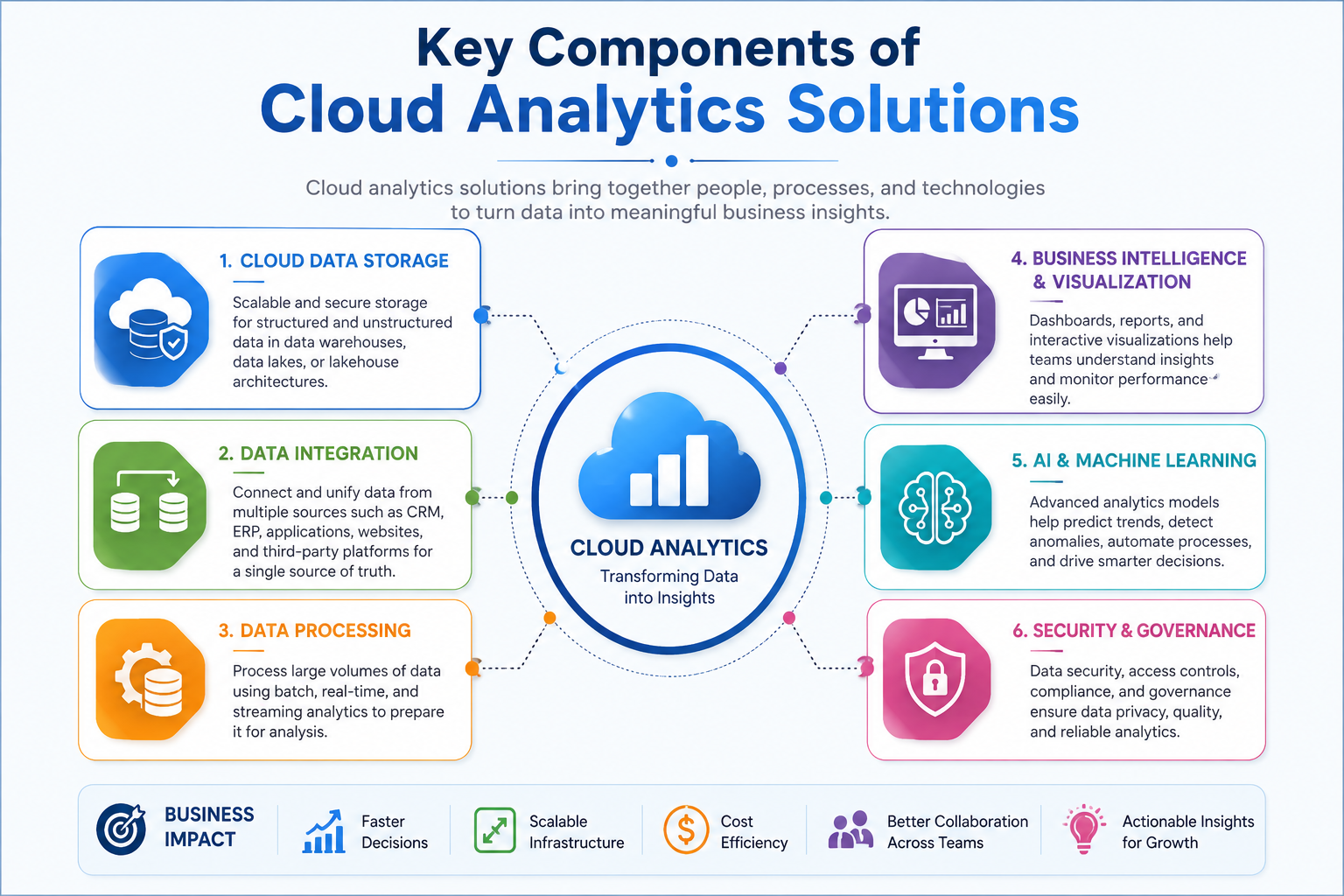
A successful cloud analytics strategy usually involves several interconnected components.
Cloud Data Storage
Cloud storage provides a scalable environment for storing structured and unstructured data.
Organizations can use cloud data warehouses, data lakes, or Lakehouse architectures depending on their data requirements, and analytics use cases.
Data Integration
Businesses often have data distributed across CRM systems, ERP platforms, applications, websites, databases, and third-party services.
Data integration technologies help bring these different sources together so organizations can analyze information more consistently.
Data Processing
Large datasets need to be processed before they can deliver meaningful insights.
Cloud processing technologies can support batch processing, real-time analytics, and complex data workloads while allowing organizations to scale resources according to requirements.
Business Intelligence and Visualization
Analytics becomes more useful when business users can understand the results easily.
Dashboards, reports, charts, and interactive visualizations can help teams identify trends and monitor important performance indicators.
Artificial Intelligence and Machine Learning
AI and machine learning can take cloud analytics beyond descriptive reporting.
Organizations can use advanced analytics to identify patterns, detect anomalies, forecast demand, personalize customer experiences, and support predictive decision-making.
How Cloud Analytics Can Transform Business Operations
Cloud analytics is not limited to reporting. It can influence multiple areas of an organization.
Marketing and Customer Analytics
Marketing teams can analyze customer behavior, campaign performance, website interactions, and conversion data.
These insights can help businesses understand which campaigns perform best and where customers drop out of the buying journey.
Financial Analytics
Finance teams can use analytics to monitor revenue, expenses, cash flow, profitability, and financial trends.
Automated dashboards can provide management with a clearer view of financial performance and support more informed planning.
Operational Analytics
Organizations can monitor operational metrics, identify bottlenecks, and analyze resource utilization.
For example, manufacturers can analyze production data to identify inefficiencies and potential equipment issues.
Supply Chain Analytics
Cloud analytics can help businesses analyze inventory, supplier performance, demand patterns, and logistics data.
Better visibility can support improved inventory planning and help organizations respond to supply chain disruptions.
Cloud Analytics and Real-Time Business Intelligence
Businesses increasingly need insights while events are happening not days or weeks later.
Real-time analytics can process continuously generated data and provide organizations with faster visibility into important business activities.
For example, an e-commerce company can monitor website traffic, transactions, inventory levels, and customer activity in near real time.
This allows teams to respond quickly to:
-
Sudden changes in demand
-
Website performance issues
-
Inventory shortages
-
Unusual transactions
-
Customer behavior changes
Real-time analytics can therefore turn business data into an operational advantage.
Security and Governance in Cloud Analytics
Moving analytics workloads to the cloud does not eliminate security responsibilities.
Organizations need appropriate controls to protect sensitive information and maintain data quality.
A strong cloud analytics strategy should consider:
Data Security
Businesses should implement appropriate identity and access controls, encryption, monitoring, and security policies to protect data.
Data Governance
Data governance helps organizations define how data is collected, accessed, managed, and used.
Clear ownership and governance policies can improve data quality and reduce inconsistencies across departments.
Compliance
Organizations operating in regulated industries may need to meet specific legal and regulatory requirements.
Cloud analytics environments should therefore be designed with relevant compliance, privacy, and data protection requirements in mind.
How to Choose the Right Cloud Analytics Solution
Not every business has the same analytics requirements. Choosing a solution should start with business objectives rather than technology alone.
Consider these factors:
Define Your Business Goals
Identify the problems you want analytics to solve.
Are you trying to improve customer retention, optimize operations, reduce costs, forecast demand, or improve financial visibility?
Evaluate Data Sources
Understand where your data currently exists and whether those systems can integrate effectively with the analytics environment.
Consider Scalability
Choose an architecture that can support your expected data growth and changing workloads.
Prioritize Security
Evaluate access controls, encryption, monitoring, governance, and compliance capabilities before moving sensitive workloads.
Focus on Usability
Analytics should not be limited to technical teams. Business users should be able to access dashboards and insights without requiring advanced technical knowledge for every request.
Common Challenges of Cloud Analytics
Although cloud analytics provides significant benefits, implementation can involve challenges.
Data silos: Information spread across disconnected systems can make integration difficult.
Poor data quality: Inaccurate or incomplete data can lead to unreliable insights.
Security concerns: Sensitive business information requires appropriate security and access controls.
Skills gaps: Organizations may need professionals with expertise in cloud platforms, data engineering, analytics, and AI.
Migration complexity: Moving existing data and analytics workloads to a cloud environment requires careful planning.
Addressing these challenges early can make cloud analytics initiatives more successful.
The Future of Cloud Analytics
Cloud analytics is evolving alongside artificial intelligence, automation, real-time processing, and increasingly complex data environments.
The future is moving from simply asking “What happened?” to answering questions such as:
-
Why did it happen?
-
What is likely to happen next?
-
What action should we take?
AI-powered analytics can help organizations discover patterns and generate insights faster, while automated data pipelines can reduce repetitive manual processes.
As businesses become increasingly data-driven, the combination of cloud infrastructure, analytics, AI, and automation is likely to play an even greater role in business decision-making.
Why Businesses Should Consider Cloud Analytics Today
Data is one of the most valuable resources available to modern organizations, but its value depends on how effectively it is used.
Cloud analytics solutions for modern businesses provide a flexible way to connect data, scale analytics capabilities, improve visibility, and support faster decision-making.
The right solution is not simply moving analytics to the cloud. It is about creating an environment where trusted data can reach the right people at the right time and support measurable business outcomes.
Businesses that build a strong foundation around data quality, security, governance, analytics, and AI can turn their growing data volumes into a competitive advantage.
How Dhanyaayai Can Help
At Dhanyaayai, we help businesses explore modern technology solutions that connect data, analytics, cloud infrastructure, and business objectives.
Our approach focuses on understanding your business requirements and identifying technology strategies that can improve visibility, efficiency, scalability, and decision-making.
Whether you are modernizing an existing analytics environment or building a cloud-based data strategy, the right architecture can help you get more value from your data.
Ready to turn your business data into actionable insights? Connect with Dhanyaayai to explore the right cloud analytics strategy for your organization.
Frequently Asked Questions
What are cloud analytics solutions?
Cloud analytics solutions use cloud-based technologies to collect, store, process, analyze, and visualize business data. They help organizations access insights without depending entirely on traditional on-premises analytics infrastructure.
What are the benefits of cloud analytics for businesses?
Key benefits include scalability, faster data analysis, improved accessibility, reduced infrastructure management, better collaboration, and support for advanced analytics and AI.
Is cloud analytics suitable for small businesses?
Yes. Cloud analytics can be useful for businesses of different sizes because cloud resources can scale according to requirements. Smaller businesses can start with specific analytics use cases and expand as their data needs grow.
How does AI work with cloud analytics?
AI and machine learning can analyze large datasets to identify patterns, detect anomalies, generate predictions, and support automated decision-making.
How can businesses get started with cloud analytics?
Businesses should begin by identifying their key objectives, evaluating existing data sources, assessing security and governance requirements, and selecting an analytics architecture that can scale with future needs.